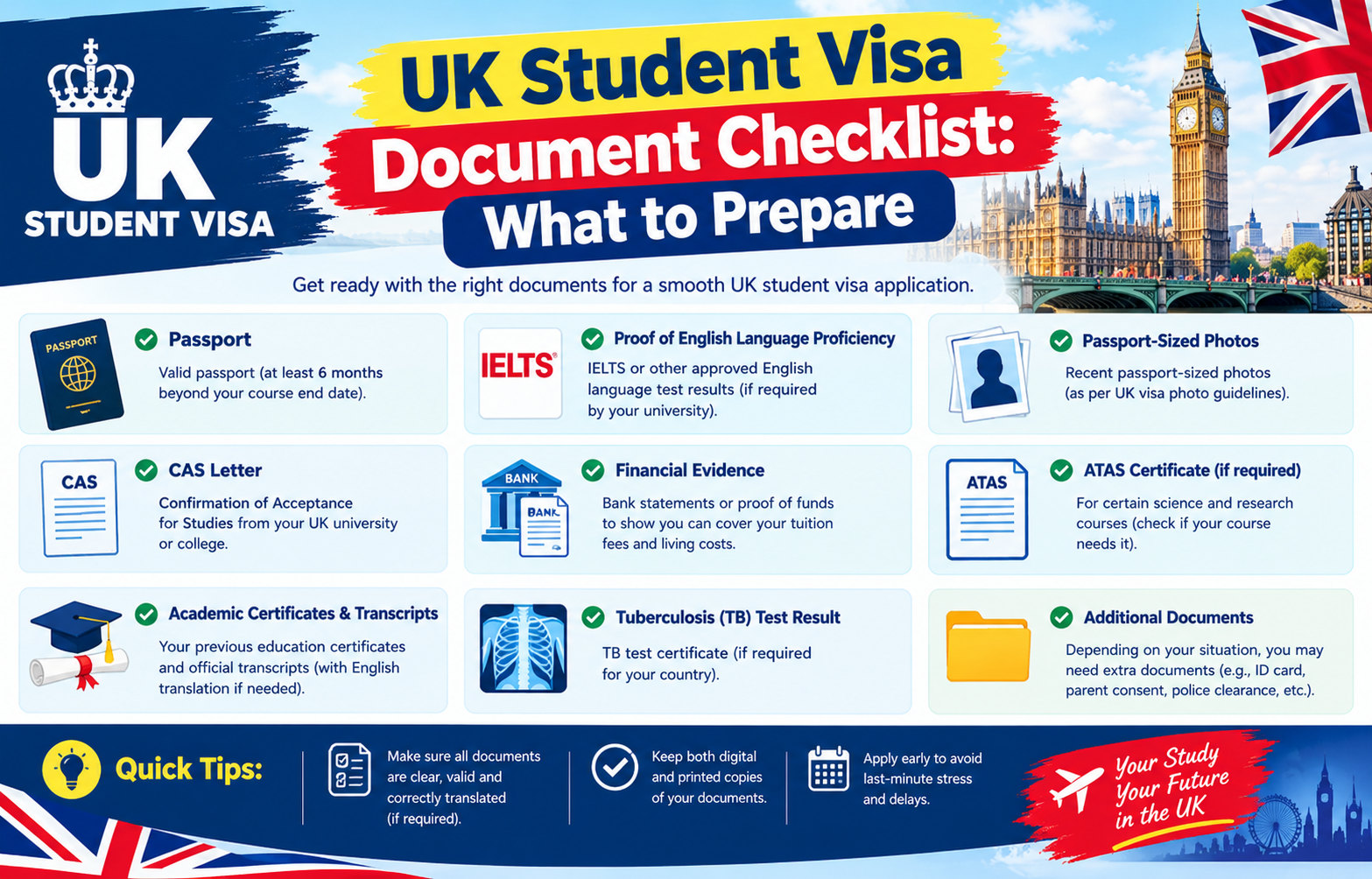
A UK Student visa document checklist is not exactly the same for every applicant. Everyone must provide a current passport or other valid travel document and a Confirmation of Acceptance for Studies (CAS) from a licensed student sponsor. Depending on your circumstances, you may also need financial evidence, an Academic Technology Approval Scheme (ATAS) certificate, a tuberculosis (TB) test result, parental consent, or evidence connected with sponsorship.
Use this guide to organise your evidence, then compare it with the current application instructions and your CAS before submitting. A document listed as “may be required” is not automatically required for every student. Equally, an exemption from uploading evidence at the start does not always mean you can ignore the underlying requirement.
Sources checked October 14, 2026. UK immigration requirements, financial thresholds and application instructions can change. The live GOV.UK guidance and the instructions in your own application take priority.
The core documents for a UK Student visa
Start with the two documents that apply to every Student visa application:
- A current passport or valid travel document. Check that it will be the document you intend to use for your journey and that your application details match the personal information shown in it.
- Your Confirmation of Acceptance for Studies (CAS). Your licensed education provider issues a CAS reference for your course. You enter this reference in the application; it is not a substitute for completing the application or meeting the other requirements.
Review the CAS as soon as you receive it. Confirm that your name and other identifying details are correct and that the sponsor, course, start date and tuition-fee information match your plans. If something is wrong or a payment is missing, contact the sponsor before applying and ask whether the CAS record needs to be corrected. Do not guess at an error or silently change information in the application.
Financial evidence: work out whether you need it
Many applicants need to meet a financial requirement covering unpaid course fees and living costs. The exact calculation depends on the course, study location, any course fees already paid and the applicant’s circumstances. The CAS is important because it records the course fee and may show payments or sponsorship that affect the amount still to be demonstrated.
As of the source-check date, GOV.UK states a monthly living-cost amount of £1,529 for courses in London and £1,171 for courses outside London, for up to nine months. These figures can change, so do not rely on a saved checklist when preparing a later application. Check the live financial requirement for the date and route on which you apply. A residential independent-school student may have boarding fees assessed differently.
Where the financial requirement applies, the required funds generally need to be held for a continuous 28-day period, with the end of that period falling within 31 days of the application date. The type of account, acceptable evidence and rules for funds held by a parent or financial sponsor can matter. A bank statement showing a large balance on one day may not prove the required holding period or show that the money is available to you.
Some applicants may not need to submit financial evidence with the initial application because of their immigration history or the differential-evidence arrangements for certain nationalities. That is not permission to make unsupported claims: UK Visas and Immigration (UKVI) can ask for evidence before deciding the application. Keep suitable financial records available and follow any request by its deadline.
If you use a student loan or official financial sponsorship, prepare the letter or evidence required for that funding route. A sponsor’s letter should accurately identify what it covers and for what period. A scholarship or tuition payment may affect the calculation, but only when it is documented in the way the rules require.
Documents that depend on your course or circumstances
ATAS certificate
An ATAS certificate is required only for certain courses and applicants. Whether you need one depends on factors such as the course and your nationality. Check before applying; if it applies, allow time to obtain the certificate and make sure its course details match your CAS. Do not assume every postgraduate student needs ATAS, or that every course is exempt.
Tuberculosis test result
A TB test certificate may be required depending on where you have lived and the length and type of application. Check the current UK government test guidance for your situation and use an approved clinic where the rules require it. If a certificate is required, confirm that it will still be valid when you apply.
Evidence for applicants under 18
Applicants under 18 need written consent from their parent or legal guardian. The consent must address the visa application and the student’s travel and living or care arrangements in the UK. The applicant also needs evidence of the relationship, such as a birth certificate or another government-issued document showing the parent’s name. The required consent arrangements can depend on who has parental responsibility, so check the rules for your family situation.
Financial-sponsor consent
If a government, international scholarship agency, university or other financial sponsor has paid your course fees and living costs in the last 12 months, you may need written consent from that sponsor for the Student visa application. Check the current instructions and the wording required from the sponsor. A funding award letter and permission to make an immigration application are not always the same thing.
English-language and qualification evidence
Applicants must meet the English-language requirement that applies to their course and circumstances. The evidence route can differ: the sponsor may assess English in some cases, while another applicant may need a qualifying test or an eligible qualification. Check what the sponsor recorded in the CAS and what the current rules require for your application. Do not book a test or omit evidence based only on another student’s experience.
Your sponsor may have assessed academic qualifications when deciding to issue the CAS. Keep certificates, transcripts and other records available, especially if they support information in your application or if UKVI asks to see them. The CAS does not mean that every applicant is exempt from providing every supporting document.
Translations, scans and document preparation
Documents that are not in English or Welsh may need a full translation. Follow the current translation instructions: a translation may need to identify the translator, confirm that it is an accurate translation, and include a date and contact details. Translate relevant stamps, notes and reverse-side information too; do not submit a partial translation that leaves important details unexplained.
Prepare clear, complete scans or photographs. Check that names, dates, account information, stamps and all page edges can be read. Keep the original documents and a copy of every file you upload. Use simple file names so you can identify each document, and attach it to the correct section if the online system asks you to categorise uploads.
Do not alter a bank statement, CAS, certificate or translation to make it appear to meet a requirement. If a record contains an error, ask the organisation that issued it how to correct or explain it. If information differs between documents, resolve the discrepancy or prepare a truthful explanation before submission.
How to check your personal checklist
- Confirm the route and course. Check that the Student route is appropriate for your age, course and sponsor. A person under 18 at an independent school may need to consider the Child Student route instead.
- Check your CAS first. Match its reference, sponsor, course and fee details against your documents and application.
- Calculate funds individually. Use the current maintenance rules, course fees, payments and any applicable exception; do not copy another applicant’s calculation.
- Identify conditional documents. Check whether ATAS, a TB certificate, under-18 consent, sponsor consent or other evidence applies to you.
- Check translations and file quality. Make sure the required pages are complete, readable and translated as instructed.
- Follow the application’s own instructions. The online form may tell you how to prove identity and where to provide documents. Keep the confirmation and copies of what you submit.
Applying, identity checks and what happens next
Student visa applications are submitted online. For an application from outside the UK, GOV.UK says applicants can usually apply up to six months before the course starts. Some applications made inside the UK can be submitted up to three months before the course starts, subject to the rules for switching or extending and the applicant’s current permission.
As part of the application, you will be told how to prove your identity. Depending on your circumstances, you may use the UK Immigration: ID Check app and a UKVI account, or attend a visa application centre to provide fingerprints and a photograph. Follow the route shown to you rather than assuming every student needs the same appointment.
Published processing times are estimates, not a decision guarantee. GOV.UK currently gives usual decision times of three weeks for applications made outside the UK and eight weeks for applications made inside the UK; complex cases or document checks can take longer. Avoid making non-refundable travel plans based only on a typical processing estimate.
If the application is successful, you will receive an eVisa and instructions for accessing it through a UKVI account. Keep your travel document details up to date in the account and check that the immigration record matches the passport you will use to travel. For related cost planning, see our UK Student visa fees and living-funds guide.
Common checklist mistakes to avoid
- Assuming every applicant must upload exactly the same evidence.
- Treating a nationality-based evidence arrangement as proof that no funds are required.
- Using an old maintenance amount or an outdated version of a checklist.
- Submitting a CAS with a discrepancy that the education provider has not corrected.
- Providing a statement that shows only a closing balance when the rules require a holding period.
- Forgetting a required translation, consent document, ATAS certificate or TB result.
- Assuming that a CAS or document checklist guarantees visa approval.
Quick UK Student visa document checklist
Before submitting, confirm that you have a current passport or travel document and a valid CAS. Then check whether your individual case also requires financial records, English-language evidence, ATAS, a TB certificate, under-18 consent and relationship evidence, or written consent from a recent financial sponsor. Prepare certified translations where required, retain copies, and follow the identity-check instructions generated by your application.
Frequently asked questions
Does every UK Student visa applicant need bank statements?
No. Whether you must provide financial evidence depends on your circumstances and the evidence rules that apply. Even if you do not need to upload it initially, UKVI may request it. Check the current financial guidance and keep supporting records available.
Is the CAS enough to apply?
No. A CAS is required, but applicants must also complete the online form, prove identity and meet other requirements that apply to their circumstances. Additional documents may be required.
Do I need to attend a visa application centre?
Not necessarily. The identity process depends on your circumstances. Some applicants use the UK Immigration: ID Check app; others are instructed to attend a visa application centre for biometrics. Follow the instructions in your application.
Where should I verify the final document list?
Check the official Student visa documents you must provide guidance and the instructions shown in your own application. For the online process and identity checks, use the official Student visa application guidance.
Information checked October 14, 2026. Requirements and financial amounts can change. This guide is general information, not an individual eligibility assessment or legal advice; official GOV.UK instructions control.