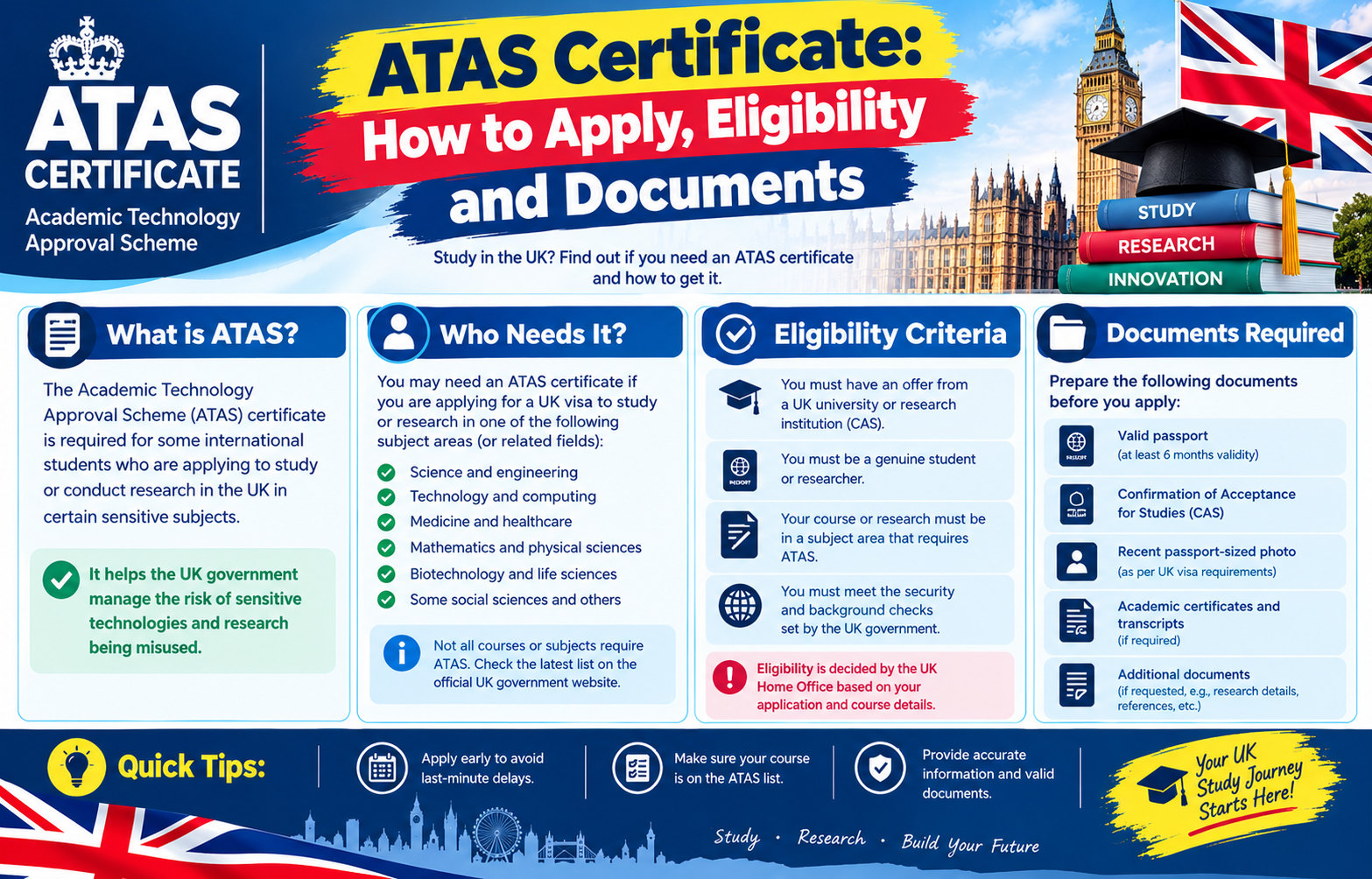
To apply for an Academic Technology Approval Scheme (ATAS) certificate, first confirm that your course, research or role requires one. ATAS is a free UK government clearance process for certain sensitive subject areas. It does not apply to every international student, every researcher or every science and engineering course. The requirement depends on the subject or research area, the relevant CAH3 code, your nationality and, in some cases, your immigration status.
The most reliable starting point is your university or research institution’s offer letter or ATAS information sheet. It should tell you whether a certificate is required and provide the course-specific information you need. This guide explains how to prepare and submit an application while distinguishing general FCDO rules from instructions that apply only at a particular university.
Sources checked October 14, 2026. ATAS guidance and the online form can change. Check the current official instructions before applying; do not rely on screenshots or an old university PDF as the final authority.
What is an ATAS certificate?
The Academic Technology Approval Scheme is administered by the UK Foreign, Commonwealth & Development Office (FCDO). It applies to certain foreign students and contracted researchers whose proposed studies or work involve specified sensitive technology-related subject areas. The certificate records the relevant course or research, institution and other application details.
ATAS is separate from a Student visa, an offer of admission and a Confirmation of Acceptance for Studies (CAS). If ATAS is required, receiving an offer does not replace the certificate, and having an ATAS certificate does not itself grant immigration permission. The institution may require a valid certificate before enrolment or before you begin the relevant course or research. For some visa routes, the certificate must also be in place before you submit the visa application.
Check whether you need to apply
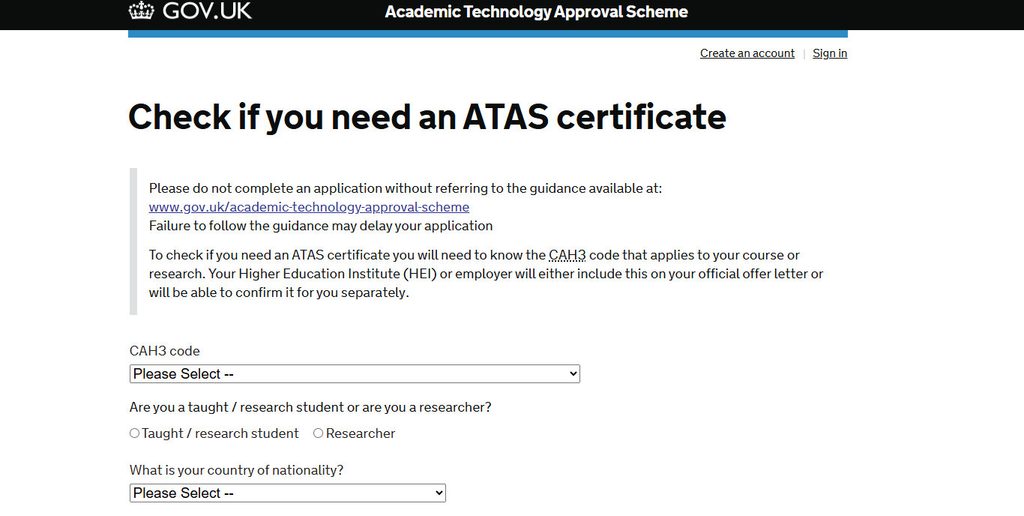
Do not decide from your course title alone. The requirement is tied to the official subject classification and the details of the proposed course or research. Ask the department or institution that made your offer whether ATAS applies, and check the CAH3 code and instructions they supplied. You can also use the official FCDO checker linked below.
Nationality matters too. Some nationalities are exempt under the current rules, but residence in an exempt country is not the same as being a national of one. Dual nationals should check the rules for their actual passport and immigration circumstances. If you are already in the UK, changing course or research area does not automatically remove the ATAS requirement.
ATAS may apply to some taught courses, postgraduate research, certain integrated master’s courses and contracted research roles. Student and researcher applications use different routes. A postgraduate student who also does research should follow the student application route when the FCDO guidance says they are applying as a student; the researcher option is not a general alternative for all PhD applicants.
Information to prepare before starting
The online form asks for detailed information. Collect it before you begin so that you can use the information provided by your institution and avoid guessing. Depending on your applicant type, prepare:
- Course or research details: the institution’s full name, the exact course or research title, the CAH3 code, qualification, course dates and supervisor or project lead details when requested.
- Institution-approved academic material: the module list for a taught course, or the research description agreed with your supervisor or institution for a research programme. Use the supplied material as instructed; do not replace technical terms with a new description.
- Identity and contact information: your full name, date of birth, current address and passport details. Use the passport information relevant to the application and expected visa process.
- Education history: previous undergraduate and postgraduate study, including dates and whether a course is complete or ongoing where the form asks for it.
- Employment history: relevant previous or current work details. Explain gaps in the way the form requests; do not invent employment to make a timeline look continuous.
- Published work: details of published papers when applicable. If a question does not apply, answer it accurately rather than leaving a required section incomplete.
- Referees: the full names and contact details of two referees, following the current FCDO criteria. The guidance says they should ideally have known you for over three years; one should be from your home country and the other should be an academic referee. Check the official instructions if you cannot meet this pattern.
- Funding and sponsorship: details of financial sponsors or funding arrangements. If a decision is pending, the FCDO guidance says to state that accurately where the form asks.
Names, dates, passport details and academic information should agree with the records held by your institution. If the offer letter, passport or research statement contains an error, ask the issuing institution how to resolve it before submitting. A mismatch can create questions or delay; silently changing an institution-approved research statement is not a safe fix.
How to apply for an ATAS certificate
1. Get the requirement and CAH3 code confirmed
Read your offer letter or official ATAS information from the university. Confirm whether clearance is required and obtain the correct CAH3 code and course or research details from the institution. Do not select a code from an unofficial list or copy one from another student, even if the course names look similar.
2. Use the correct applicant route
Create or sign in to the official ATAS account and choose the category that matches your situation. The FCDO guidance distinguishes student applicants from contracted researchers and gives additional instructions for visiting students and researchers. If you are unsure which category applies, ask your institution before completing the form.
3. Complete every relevant section accurately
Enter information carefully and use the institution-approved course, module or research material. Supply the education, work, referee and sponsor information requested for your route. The application may include free-text questions about your proposed study, reasons for undertaking it or future plans. Your answers must reflect your real background and plans, not a generic example copied from a website.
4. Review the application before submission
Check spelling, dates, passport details, CAH3 code, course title, institution and research information against your original documents. Confirm required sections are complete and that names of referees, employers and financial sponsors are written as requested. The FCDO warns that false, misleading, incomplete or unverifiable information can lead to refusal.
5. Submit and keep a record
Submit through the official service and save your application reference or confirmation. The ATAS application is free. Do not pay a third party that claims it can guarantee clearance or speed up a decision. The FCDO says the system does not accept duplicate applications; submitting the same application again is not a way to move it forward.
Using AI and application-writing help safely
The FCDO allows AI tools to help improve clarity or structure, but applicants remain responsible for every answer. Do not use AI, an agent or another person to create or alter facts about your identity, qualifications, work experience or research. Do not paste in a fabricated research proposal, referee information or personal history. Verify every sentence against your real records and the material agreed with your institution before submitting.
For research descriptions and module lists, follow the institution’s instructions. Some universities ask students to copy an agreed statement exactly; others provide a different process. These are institution-specific directions, so do not assume that another university’s template or advice applies to your course.
Email, processing time and certificate validity
As of October 14, 2026, GOV.UK warns applicants not to use Gmail within the ATAS application because of an ongoing technical issue. Use an alternative email address and check the live notice before applying, since technical notices can change. After submission, monitor the account and the email address used, including junk or spam folders.
The FCDO currently says ATAS applications take at least 30 working days to process; complex applications can take longer, and demand may increase during the busier April-to-August period. There is no fast-track service. These are minimum processing expectations, not a guaranteed completion date. Plan with your university’s course and visa deadlines in mind, and apply as soon as the required information is ready.
For a visa application, the certificate is valid for six months from its issue date. The FCDO also says it remains valid for the duration of the course or research while you hold valid UK immigration permission, provided the relevant details remain applicable. Check the dates and details printed on your own certificate and confirm with the institution if your start date or circumstances change.
After submission: decision, errors and changes
The outcome is sent by email, and the institution or research organisation is also informed. If approved, check that the certificate details match your passport and the course or research approved by your institution. Follow the university’s instructions about when to provide the certificate and whether it must be included with your visa application.
If you notice a problem after submitting, do not create a duplicate application as a shortcut. Follow the FCDO instructions for contacting the ATAS team. The official guidance says that only limited details can be changed in a pending application; if a passport is lost or expires while an application is pending, contact the ATAS team as instructed.
A new certificate may be needed if relevant course or research details change, such as a change to course content or primary supervisor. The FCDO also identifies a course end-date delay of three months or more as a situation requiring a new certificate. Because the exact effect depends on your case, notify your institution and check the current official rules before continuing study or research under changed details.
If an application is refused, read the official outcome and appeal information. The FCDO says an applicant must wait 90 days before applying again for the same course or research at the same institution with the same CAH3 code. Do not treat this as a universal waiting period for every different course or institution; check the rule that matches your situation.
Common ATAS application mistakes to avoid
- Assuming ATAS is required for every international student or every STEM course.
- Using residence instead of nationality when checking an exemption.
- Entering a CAH3 code or course details that were not confirmed by the institution.
- Changing an agreed research statement or using a generic sample as if it were personal information.
- Leaving gaps in education or employment history unexplained when the form asks for details.
- Using an email provider currently flagged in official technical guidance.
- Submitting a duplicate application or paying an unofficial service that promises approval.
- Assuming the certificate is a visa or that it guarantees permission to study.
ATAS application checklist
Before you submit, confirm that ATAS applies to your course and nationality; obtain the correct CAH3 code and institution-approved course or research details; select the correct student or researcher route; gather passport, education, employment, referee and sponsor information relevant to your application; use an email address permitted by the current FCDO notice; and review every answer for accuracy. Keep the confirmation and monitor your email and application account while waiting.
For related UK study costs, see our UK Student visa fees and living-funds guide. The ATAS application itself is free; visa fees, healthcare surcharge and other study costs are separate.
Frequently asked questions
How much does an ATAS certificate application cost?
The ATAS application is free. You should apply through the official government service, not a paid website promising faster processing or guaranteed approval.
How long does an ATAS application take?
The FCDO currently says applications take at least 30 working days, and complex cases or busy periods may take longer. There is no fast-track service, so do not treat the minimum as a guaranteed decision date.
Can I use AI to write my ATAS application?
AI may help with clarity or structure, but it must not invent or change personal, academic, employment or research facts. You are responsible for the information submitted, and unverifiable information can lead to refusal.
Where do I check the current rules and start an application?
Read the FCDO’s official ATAS guidance to check eligibility, evidence and current notices. If you need a certificate, use the official ATAS application service.
Information checked October 14, 2026. ATAS requirements, form details and processing times may change. This article is general information, not an individual eligibility decision or legal advice. Current FCDO and institution-specific instructions control.