Source check: October 21, 2026. U.S. visa rules and employer procedures can change. Always confirm the current requirements for your specific visa category before accepting a job or paying any application-related cost.
Finding jobs with visa sponsorship in the USA means finding a real U.S. employer and a real vacancy that may fit a particular immigration category. It does not mean that every company can sponsor every worker, or that a job offer automatically gives you permission to work in the United States. The suitable route depends on the duties, qualifications, employer, length of employment, your nationality and other facts.
This guide explains the main employer-sponsored routes, where to look for vacancies, how to assess an employer’s sponsorship history and how to recognize warning signs. It is general information—not a job offer, visa decision or promise of sponsorship.
What does “visa sponsorship” mean?
In everyday job advertisements, “visa sponsorship” usually means an employer is willing to take one or more formal steps to support a worker’s U.S. immigration process. Depending on the category, the employer may need to file a petition, obtain a labor certification or complete other government procedures. The worker may then need to apply for a visa at a U.S. embassy or consulate, or follow a different process if already in the country.
The phrase is not a visa category by itself. An employer might sponsor certain roles but not others, or might consider international applicants only when they meet specific requirements. A company’s past sponsorship does not prove that it has a suitable vacancy now. Also, a U.S. company offering remote work from your home country is not necessarily offering a route to relocate and work physically in the United States.
Main U.S. work visa and employment-based routes
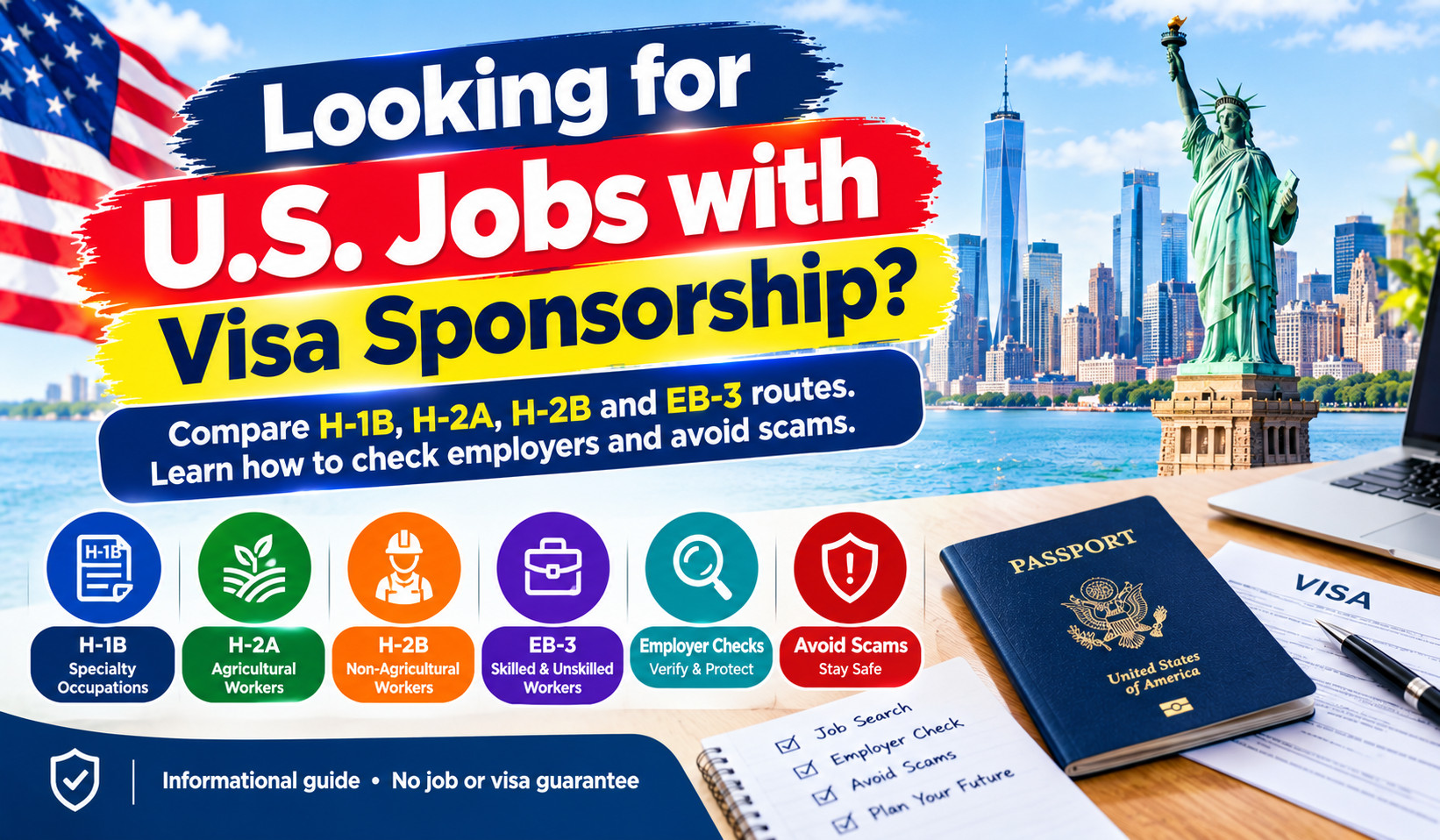
- H-1B jobs: This route is commonly associated with specialty-occupation positions requiring specialized knowledge and relevant qualifications. An employer must be willing and eligible to petition for the particular role. Some cases are subject to annual registration or selection procedures, so an offer alone does not guarantee a petition can proceed or that a visa will be issued. For a separate explanation of registration and selection, read our H-1B registration and selection guide.
- H-2A farm jobs: H-2A is for temporary agricultural work. The job, employer and need must meet the program rules. These opportunities are tied to specific employers, locations, duties and work periods; they are not general permission to work for any farm.
- H-2B seasonal jobs: H-2B covers certain temporary non-agricultural jobs. Employers must meet program requirements, including the required labor-market steps. Some jobs are seasonal; others may be based on a different qualifying temporary need. A job title alone does not prove eligibility.
- EB-3 employer-sponsored permanent residence: EB-3 is an employment-based route toward permanent residence for eligible professionals, skilled workers and certain other workers. It is different from a temporary work visa. The employer and position generally need to meet specific requirements, and labor certification is part of many cases. Visa availability and processing stages can affect the overall timeline.
Other categories may fit particular circumstances. L-1 is associated with qualifying transfers within a company; O-1 is for people who meet the high evidentiary standard for extraordinary ability; and TN or E-3 eligibility is limited by nationality and category-specific rules. These are not general sponsorship options for all international applicants. The Department of State’s employment visa information explains that the appropriate category depends on the planned employment and the applicant’s circumstances.
Which jobs and industries may offer sponsorship?
International applicants often search for software engineer H-1B jobs, healthcare jobs with visa sponsorship, engineering roles, research positions, university jobs, farm work or seasonal hospitality and landscaping jobs. These are search areas, not guarantees. A technology company may sponsor some specialized roles but not every IT vacancy. A hospital may recruit internationally for a particular position but still require the applicant to meet professional licensing and immigration requirements. Farm and seasonal positions must fit the relevant temporary-worker program.
For healthcare work, check both immigration eligibility and the licensing rules for the exact profession and state. For software and other professional roles, compare the real job duties and required qualifications with the employer’s stated sponsorship policy. For seasonal work, review the location, dates, pay, duties, housing details and employer information—not just the job title.
How to find visa sponsorship jobs in the USA
- Choose the route before searching. Decide whether you are looking for a temporary job, a professional role or an employer-sponsored permanent-residence route. If you do not know which category could apply, research the official requirements before assuming that a job-board label is accurate.
- Search specific roles, not only “sponsorship jobs.” Combine your occupation with phrases such as “visa sponsorship,” “H-1B sponsorship,” “H-2A job order,” “H-2B temporary position” or “employment-based green card.” Then check whether the employer’s own careers page carries the same vacancy.
- Use official seasonal listings for seasonal work. The Department of Labor’s SeasonalJobs search portal lists seasonal and temporary job opportunities and lets users search by occupation, title, industry, employer or location. Read the complete job order and confirm that the opportunity is still current before contacting anyone.
- Research employer history carefully. For professional roles, public government records such as the USCIS H-1B Employer Data Hub can help you investigate whether an employer has petitioned for H-1B workers in the past. Treat historical records as a research clue only: they do not confirm a current vacancy, future sponsorship, approval rate for your case or eligibility for a specific job.
- Check the exact job advertisement. Look for an explicit statement about current or future sponsorship. Phrases such as “must be authorized to work in the U.S. without sponsorship” usually indicate that the employer is not offering sponsorship for that position. If the wording is unclear, ask the recruiter before spending time on the application.
- Contact the employer with focused questions. Ask whether the company will consider applicants who need sponsorship for this specific role, which visa category it has in mind, who would file the petition and whether the job is open to applicants outside the United States. Do not assume that a recruiter’s general statement applies to every vacancy.
- Tailor your application honestly. Use a clear résumé that matches the role’s duties and required skills. State your current work authorization accurately. If you are abroad, say so; if you are already in the United States, explain your current status and any relevant work authorization without suggesting that it is unrestricted.
Who may be eligible?
Eligibility is determined by the visa category and the facts of the job—not simply by being a foreign worker or having a U.S. job offer. Requirements may concern the employer, the role’s duties, the applicant’s education or experience, the temporary or permanent nature of the job, and government filings. Some routes are limited by nationality, occupation or other conditions.
A degree is important for some professional routes, but “no degree” does not automatically settle eligibility for every employment category. Some temporary jobs have different qualification requirements, while the employer must still follow the rules for that program and the applicant must be able to perform the work. Do not rely on a recruiter who says that every foreign worker can qualify without checking the actual category.
If you are already in the United States on student or dependent status, check the work conditions that apply to you. A future employer’s willingness to sponsor you does not itself authorize you to start work. Likewise, a visitor visa is not permission to take a U.S. job. Do not begin employment until you have the required authorization.
What documents might an applicant need?
The employer usually needs information about the position and the business, while the worker may be asked for documents that establish identity and qualifications. Depending on the case, useful records may include:
- a valid passport and consistent identity details;
- résumé, employment references and evidence of relevant experience;
- degrees, transcripts, licences or professional credentials, where relevant;
- information requested for the employer’s petition or labor-certification process;
- the employer’s job offer, job duties, work location and proposed employment dates;
- forms, photographs or supporting records required for the applicant’s later visa or immigration step.
This is a preparation list, not a universal checklist. Requirements differ by category and by whether the applicant is applying from abroad or already in the United States. Follow the official instructions for the specific case and do not submit altered or misleading evidence.
What happens after a job offer?
Ask the employer to identify the proposed visa category and explain the steps it will take. Depending on the route, there may be labor-market procedures, an employer petition and then a visa application or another immigration filing. The worker may need an interview or additional checks. Each stage has its own requirements; a submitted application is not the same as an approval.
Before accepting, get the job terms in writing: employer’s legal name, worksite, duties, wages, hours, start and end dates, housing or deductions if applicable, and who will handle each immigration step. If an agency is involved, ask who the actual employer and petitioner are. Keep copies of the signed agreement and communications.
Costs and processing time
There is no single sponsorship fee or timeline for all U.S. jobs. Costs and processing depend on the route, employer filings, government charges, visa application steps, appointments and individual review. The employer and worker may have different costs, and legal rules can restrict who may pay certain expenses. Ask for an itemized explanation in writing and verify it against current official rules. Do not assume that every cost belongs to the worker—or that every employer will pay every personal expense.
Processing estimates are not guarantees. Selection procedures, petition review, visa appointment availability, requests for evidence and other case-specific checks can change how long the process takes. Do not resign, book non-refundable travel or begin work based only on an estimate or verbal promise.
How to avoid fake sponsorship offers
- Be wary of anyone selling a guaranteed job, visa approval, H-1B selection or a place in a government process.
- Do not pay an unknown person to “reserve” a job or buy a sponsorship certificate. Verify the employer and the vacancy through the company’s official website and relevant government records.
- Be cautious if there is no real interview, no written job description, an implausibly high salary, pressure to act immediately or communication only through a personal email or messaging account.
- Never send false documents, passwords or one-time security codes. Do not hand over your passport to an unverified recruiter.
- Check whether the job’s location, duties, employer name and dates are consistent across the offer, recruiter messages and any official job order.
A legitimate employer cannot promise that the government will approve a petition or visa. If an offer seems suspicious or the employer asks you to pay a questionable recruitment or filing charge, pause and seek advice from a qualified U.S. immigration attorney or an appropriate government worker-protection office.
Frequently asked questions
Do I need a job offer to get a U.S. work visa?
Many employer-sponsored categories require a qualifying job and an employer petition or other formal employer steps. The exact process depends on the category. Do not treat a general job offer as work authorization.
Can I find U.S. companies that sponsor work visas?
You can research companies that have sponsored workers in the past, including through public H-1B employer records. But past activity does not establish that a company is hiring now or will sponsor your role. Confirm the policy for the exact vacancy with the employer.
Can I get sponsorship without a degree?
Possibly for some kinds of work, depending on the visa category and job requirements. Some professional routes have specific education or equivalent qualification standards. Check the rules for the actual role; no-degree claims are not a shortcut around visa eligibility.
Does the employer pay all visa costs?
There is no universal answer across H-1B, H-2A, H-2B and EB-3. Cost responsibility depends on the category and applicable rules. Ask for a written breakdown, and do not pay for a guaranteed job or guaranteed visa result.
How long does sponsorship take?
There is no reliable one-size-fits-all timeline. Employer preparation, government processing, appointment availability and your individual case all matter. Check current official estimates for the relevant step and keep your plans flexible.
Plan your search around a real route
The strongest search for jobs with visa sponsorship in the USA starts with a genuine vacancy and a plausible immigration category. Verify the employer, read the full job terms, ask direct questions about sponsorship and use official information to check the route. Avoid anyone promising a guaranteed outcome. Careful route-specific research helps you focus on employers and opportunities that may genuinely fit your qualifications and circumstances.