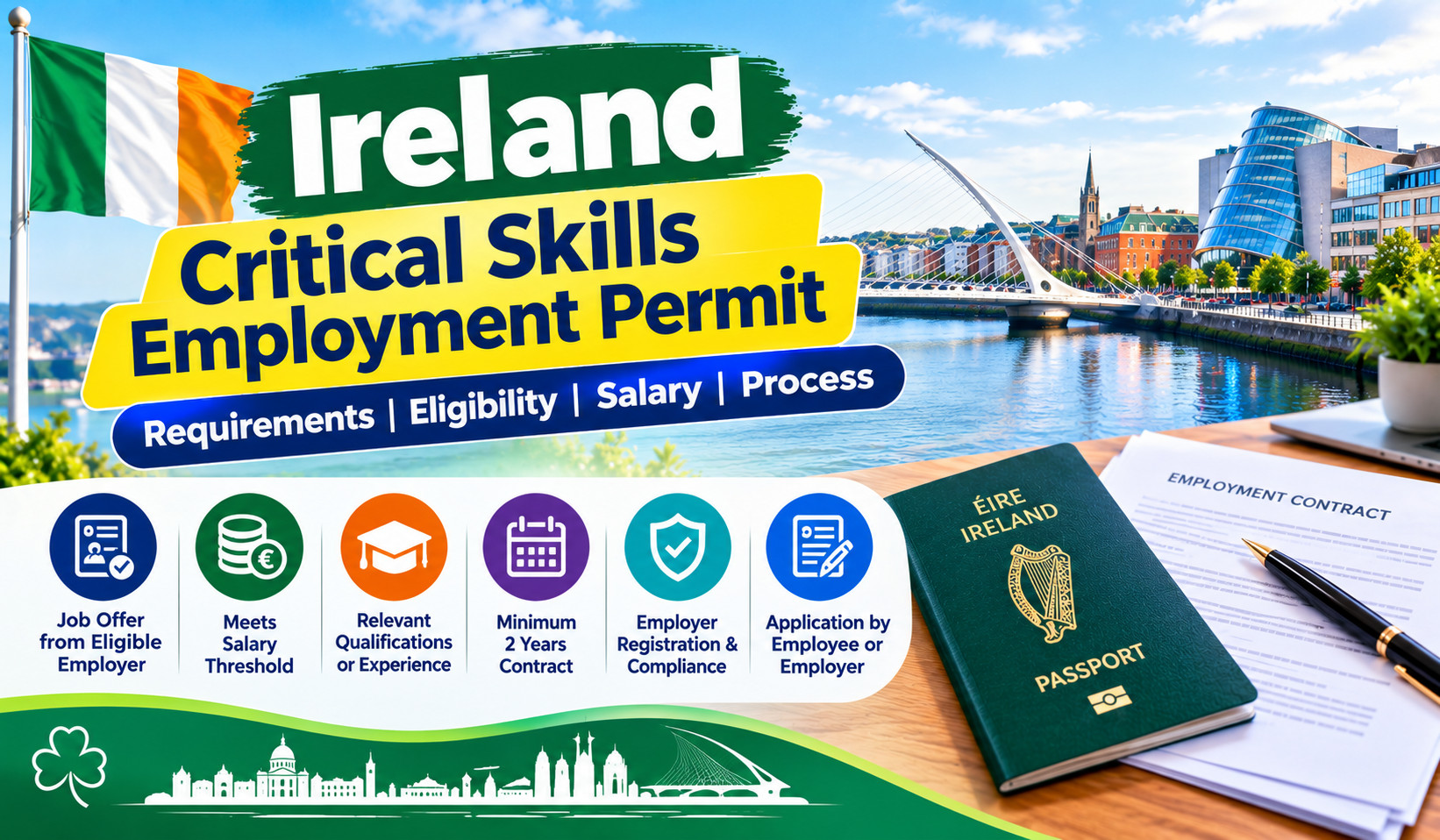
The Ireland Critical Skills Employment Permit (CSEP) is an employment permit for eligible non-EEA workers who have a qualifying job offer in Ireland. Whether you qualify depends on the actual job duties, occupation, salary, qualifications or experience, offer duration and employer—not just the job title or a promise that the employer will “sponsor” you.
Information checked October 21, 2026. Salary thresholds, occupation lists and procedures can change. Before applying, check the current official DETE Critical Skills Employment Permit guidance.
Quick answer: A CSEP applicant generally needs a qualifying Irish job offer of at least two years, a role and pay that meet one of the permit routes, and an employer that satisfies the applicable criteria. Either the prospective employee or employer can submit the permit application. The permit is not an entry visa or residence permission.
What is the Ireland Critical Skills Employment Permit?
The Critical Skills Employment Permit is designed for skilled roles where Ireland has identified a need for particular qualifications, experience or skills. The permit is tied to the named employee, employer, occupation and work location. It is not an open work permit that lets the holder take any job.
The CSEP replaced Ireland’s former Green Card Employment Permit, so older pages may use the phrase “Ireland Green Card work permit.” The current name is Critical Skills Employment Permit. It is also important to distinguish an employment permit from a work visa: the permit authorizes qualifying employment, while some nationalities also need a separate visa to travel to Ireland. Residence registration is another step after arrival.
Ireland Critical Skills Permit requirements and eligibility
To assess your Ireland Critical Skills Permit eligibility, check these conditions together:
- You have a genuine job offer from an eligible employer in Ireland.
- The job and its actual duties fit an applicable permit route.
- The offer is generally for at least two years.
- The salary meets the threshold for the selected route, using only qualifying remuneration.
- You have the qualifications, skills or work experience required for the role.
- The employer meets the applicable registration and workforce rules.
A non-EEA national will generally need an employment permit to work in Ireland unless an exemption applies. “Non-EU” and “non-EEA” are not always interchangeable for immigration purposes, so check your specific nationality and status rather than assuming that every person outside the EU follows exactly the same route.
Critical Skills Employment Permit Ireland salary thresholds
The minimum salary for an Ireland Critical Skills Permit depends on the route. The figures below are the current thresholds shown in DETE guidance as checked on October 21, 2026:
- Listed occupation route: at least €40,904 per year for an eligible occupation on the Critical Skills Occupations List, with a relevant degree or higher qualification.
- Recent qualification route: €36,848 may apply to an eligible listed occupation if the relevant qualification was received within the 12 months before the permit application.
- Public-sector pay agreement: qualifying public-sector roles covered by a pay agreement may use the rate set under that agreement.
- High-remuneration route: remuneration must be over €68,911 per year for a job that is not on the Ineligible Occupations List and is not contrary to the public interest. A candidate without a degree must have the necessary experience.
These are different routes, not a single salary requirement that applies to every applicant. In particular, the high-remuneration route is not permission to apply for an otherwise ineligible occupation. Confirm the exact rule and threshold before accepting an offer.
Which pay components count?
DETE defines qualifying remuneration using basic salary and certain employer-paid health-insurance contributions that meet the official conditions. Basic salary must also meet the applicable national minimum wage or legally fixed rate. The application asks for annual remuneration excluding bonuses.
Do not assume that a bonus, overtime, ordinary allowance or the advertised “total package” can make up a shortfall in basic pay. Ask the employer to show the salary and any qualifying health-insurance contribution separately. If the calculation is unclear, check the official rules before submitting.
Critical Skills Occupations List: which jobs may qualify?
The Critical Skills Occupations List is organized by occupational categories and specific employments. It is not a simple list where every job sharing a broad title automatically qualifies. The current list, effective from May 13, 2026, includes examples such as programmers and software development professionals, registered nurses, registered midwives, and specified engineering and health-professional roles. Some broader categories have additional specialism or qualification conditions.
That means the phrases “Critical Skills Permit Ireland for software engineers” and “Critical Skills Permit Ireland for nurses” do not have a universal yes-or-no answer based only on the job title. Check the exact duties, skills, qualifications and occupation classification. DETE can assess the role using the information in the application, including the job description and the employee’s background.
When reviewing a job, compare the main tasks—not just the title—with the occupational description. If most of the work does not fit the selected category, the job may not qualify through that listed-occupation route. Occupation lists can change, so do not rely on a saved list or an old article.
Ireland Critical Skills Permit job offer requirements
You need a real job offer before applying; the CSEP is not a job-seeker permit. The offer should clearly explain the position, duties, location, start date, hours, salary and duration. The required offer period is generally at least two years.
The employer must be a genuine business based and trading in Ireland, registered with Revenue and, where applicable, the Companies Registration Office. DETE also generally requires that at least 50% of the employer’s workforce are EEA nationals when the application is made. A limited exception can apply to certain qualifying start-ups within two years of establishment that are supported by Enterprise Ireland or IDA Ireland; the employer must check whether it meets the conditions.
A Labour Market Needs Test is not required for a CSEP. That does not remove the other employer, job, salary or applicant requirements. An employer’s willingness to hire an overseas worker is not, by itself, proof that the role is eligible.
Documents required for an Ireland Critical Skills Employment Permit
Use the current CSEP checklist and the prompts in the online application. Depending on the role and route, prepare information or evidence such as:
- Passport and personal details requested for the application.
- A signed employment contract or written job offer showing the role, duties, work location, hours, duration and salary.
- A detailed job description that explains the actual work and relevant skills.
- Degree certificates, transcripts or other qualification evidence relevant to the position.
- Work history or references if experience is needed to support eligibility.
- Employer details and any documents required to show the business meets the relevant criteria.
- Any evidence requested for a recent-graduate or qualifying public-sector pay route.
Check that names, dates, salary figures and job details match across the application and supporting documents. If a document is not in English, follow the instructions that apply to that application. Missing evidence can lead to a request for more information or affect the decision; no document or checklist can guarantee approval.
How to apply for Ireland Critical Skills Employment Permit
- Check whether you need a permit. Confirm your nationality and current immigration status; some people may be exempt from an employment permit.
- Secure the job offer. Confirm that it is genuine, describes the real role and normally covers at least two years.
- Match the occupation. Review both the Critical Skills Occupations List and any relevant ineligible-occupation rules.
- Confirm the salary route. Check the threshold, qualification or experience requirement and which pay components count.
- Prepare the evidence. Follow the latest checklist for both the employee’s and employer’s information.
- Submit online. The prospective employee or employer may apply through the Employment Permits Online System (EPOS).
- Allow for the lead time. DETE says an employment-permit application must be received at least 12 weeks before the proposed start date.
After submitting, use EPOS and official correspondence to follow the application status and respond to any request by its deadline. A submission receipt or a status update is not a permit grant. Avoid resigning, booking non-refundable travel or starting work based only on an estimate.
Ireland Critical Skills Permit fees and processing time
The published CSEP processing fee is €1,000. DETE states that 90% of the fee is refunded if the application is unsuccessful. Other costs—for example, a separate visa application or immigration registration where applicable—are not necessarily included in the employment-permit fee. Confirm current fees and any exemptions before paying.
There is no guaranteed Ireland Critical Skills Permit processing time. Applications are processed according to the Department’s published queue and the completeness of the application. In its queue update dated October 20, 2026, DETE listed CSEP applications received on October 12, 2026, as being processed. That is a snapshot of the queue, not a promise that every application takes the same number of days. Check the latest official processing dates before making plans.
After approval: work visa, arrival and family
Read the permit to confirm the employee, employer, occupation and work locations are correct. If you need an Irish long-stay employment visa, apply separately after receiving the permit and follow the instructions of the Irish mission responsible for your application. The work permit does not guarantee entry; all travellers remain subject to the relevant immigration controls.
After arrival, follow the required residence-registration process and keep your immigration permission current. Do not begin working before you have the permit and any other required permission. The permit is job-specific, so seek official guidance before changing employer, occupation or work location.
CSEP holders may be eligible to apply for family reunification. A spouse or de facto partner may qualify for an immigration permission with access to employment, but eligibility and the partner’s conditions are separate from the main applicant’s permit. Dependent children and other family members also have their own rules. Do not assume that every relative receives the same work rights automatically.
Renewal and the Critical Skills Permit Ireland to Stamp 4 process
People often search for “Ireland Critical Skills Employment Permit renewal,” but the next step is not always a straightforward renewal of the same permit. A CSEP is generally issued for two years. Eligible holders may be able to apply for Stamp 4 permission, which can allow them to work without a further employment permit.
Current Irish Immigration Service Delivery guidance lists a 21-month eligibility point for specified permit holders, measured from the commencement of employment in Ireland on the relevant basis. This is not an automatic upgrade: the person must meet the conditions, maintain the required immigration permission and apply through the appropriate process. See the official Stamp 4 upgrade guidance.
Stamp 4 is not the same as permanent residence or citizenship. If you do not qualify for the upgrade, do not assume that your permission to work continues after expiry; confirm the correct next step with the relevant authorities well before the current permission ends.
Changing employer is also restricted. DETE generally says a new permit for a different employer cannot be considered until at least nine months have elapsed since the permit holder began employment in Ireland. There may be specific exceptions, including certain redundancy circumstances, so check the rules that apply to your case before leaving or accepting a new role.
Critical Skills Employment Permit vs General Employment Permit
The CSEP is aimed at listed critical-skill roles or qualifying high-remuneration jobs, generally requires a two-year offer, and does not require a Labour Market Needs Test. A General Employment Permit has different occupation and salary rules and usually involves a Labour Market Needs Test, subject to applicable exceptions. One route is not automatically better for everyone; compare the actual job and the current rules before choosing.
If you are comparing work routes in other countries, our guides to Canada Work Permit Requirements and UK Skilled Worker Visa Requirements explain those separate systems. Their eligibility rules should not be substituted for Ireland’s.
Frequently asked questions
Who is eligible for a Critical Skills Employment Permit in Ireland?
Generally, an eligible applicant needs a qualifying Irish job offer, the required offer duration, a job and salary that meet a CSEP route, and the skills, qualifications or experience required for the role. The employer must also meet the relevant criteria.
Can I apply for a Critical Skills Permit without a degree?
Possibly. The high-remuneration route may accept an applicant without a degree if they have the necessary experience for the role and meet the other requirements. The listed-occupation route has its own relevant-qualification rules.
Can a recent foreign graduate qualify?
A reduced salary threshold may apply if the applicant received the relevant qualification within 12 months before applying and the job meets the eligible listed-occupation route. Confirm the current conditions and evidence requirements before relying on it.
Can I find a Critical Skills job in Ireland without an offer?
You can search for suitable jobs, but the CSEP application itself requires a qualifying offer. Check the employer, job duties, salary and contract terms before paying a recruiter or making relocation plans. A job advertisement is not a permit approval.
Is the application status the same as approval?
No. Check EPOS and the official decision notice. A submitted or processing status does not mean the permit has been granted, and an online status should not be treated as permission to start work.
Does the permit need to be renewed after two years?
Some qualifying CSEP holders can apply for Stamp 4 instead of a further employment permit. The upgrade is subject to separate conditions and is not automatic. If you do not qualify, verify the appropriate permit and immigration-permission steps before expiry.
Before applying, check the job duties, occupation list, salary calculation, two-year offer, employer criteria, documents and current processing queue together. Use official Irish instructions for your specific case. This article provides general information, not individual immigration or legal advice, and does not promise a job, permit or visa.