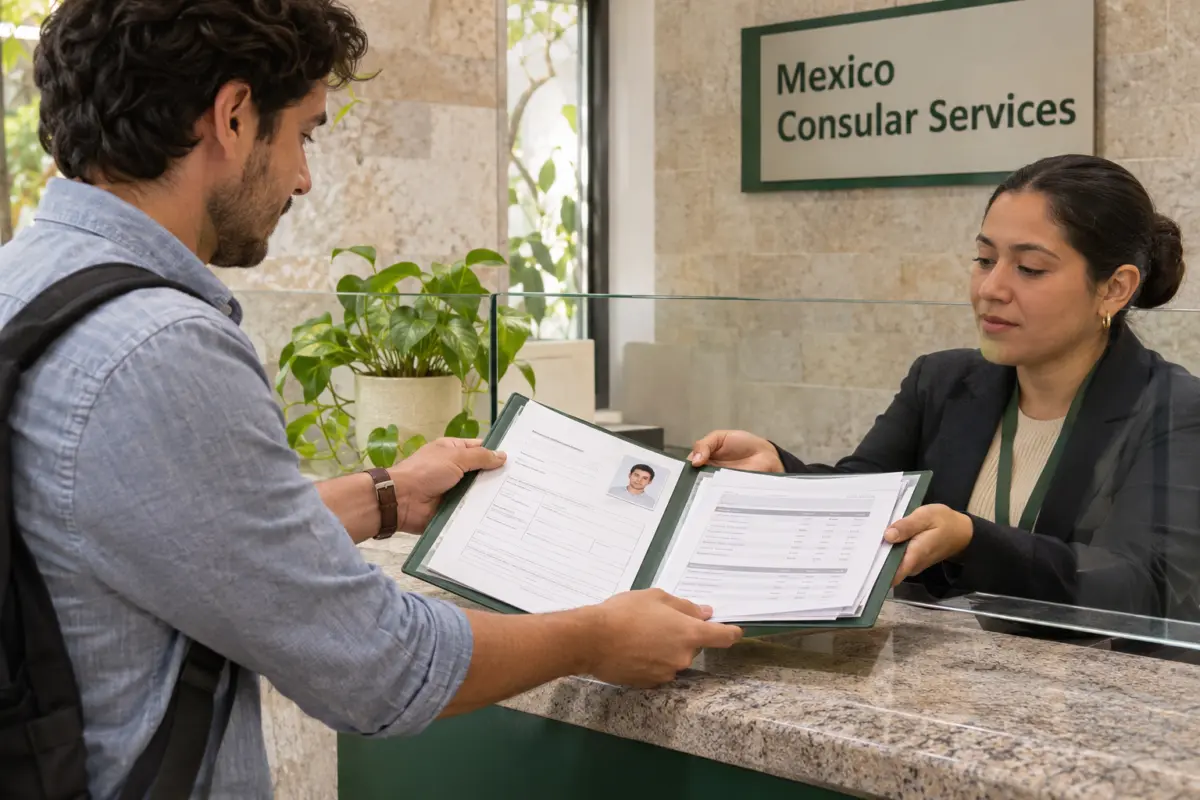
Mexico temporary resident visa requirements generally include a valid passport, the consular application, the requested photograph, the visa fee and evidence that you qualify through an accepted route. For economic solvency, prepare the required history of qualifying income or savings—not just your current balance. Most new applicants using this route start at a Mexican consulate outside Mexico, then apply for the resident card after entering the country.
Planning the next stage after temporary residence? Our guide to qualifying for permanent residency in Mexico explains the residence-time application, the student-status limitation and the documents to check before your current card expires.
The requirements depend on your category and handling office. A tourist entry exemption, U.S. citizenship or ownership of a Mexican home does not automatically establish eligibility for a temporary resident visa.
Reviewed November 4, 2026. This guide focuses on the ordinary consular application, especially financial-solvency applicants applying in the United States. It separates the visa, entry record and INM resident-card application, with a practical document checklist for each stage.
What the temporary resident visa covers
Mexico’s temporary residence category is intended for a stay longer than 180 days and no more than four years. The visa issued abroad allows you to request entry for that purpose; the residence document issued inside Mexico is a separate stage.
The official SRE temporary-resident service lists several qualifying grounds. Financial solvency is one route, alongside specified family, property, investment, invitation and international-mobility circumstances. Its combined document list covers different situations: it does not mean every applicant must produce a marriage certificate, business investment and research invitation.
This article covers eligibility and application preparation. For housing, moving costs, healthcare, tax planning, pets and customs, use our broader guide to moving to Mexico from the USA.
Who can apply, including U.S. citizens?
Start by identifying a legal basis that matches your actual purpose and evidence. U.S. applicants do not receive residence automatically because they can visit Mexico without obtaining an ordinary visitor visa.
| Your basis | Evidence to investigate | Important distinction |
|---|---|---|
| Economic solvency | Qualifying employment or pension income, or qualifying bank/investment history | Use the full evidence period and the handling office’s instructions |
| Family unity | Recognized relationship and the relative’s nationality, visa or resident status | The exact relationship and application location affect the procedure |
| Mexican employment offer | The applicable INM authorization obtained through the employer | A job offer is not simply another bank-statement application |
| Property or investment | The specified qualifying ownership or investment documents | Buying any property or starting any business does not guarantee approval |
| Invitation or international agreement | Documents required for that particular arrangement | Its conditions differ from ordinary financial solvency |
Temporary student residence is a distinct category. Do not use this financial checklist in place of the student instructions. Permanent residence, renewal of an existing card and permission for local employment also require separate assessments.
If you are not a national of the country where you apply, prepare the required evidence of lawful presence there. For example, a non-U.S. citizen applying in the United States needs to check the office’s accepted status documents. Lawful U.S. status and Mexican residence eligibility are different questions.
Mexico temporary resident visa documents checklist
Build the packet from the chosen office’s current instructions. Use the table as an organizer, then mark each item required, not applicable or awaiting confirmation for your case.
| Document | What to check | Typical avoidable problem |
|---|---|---|
| Passport or accepted travel document | Validity, identity details and requested copies | Different names across the passport, form and financial records |
| Application form | Correct version, complete personal information and signature instructions | Submitting a different visa category or leaving necessary fields unresolved |
| Photograph | Office-specific size, background, recency and print requirements | Assuming a U.S. passport-photo specification must be accepted |
| Qualifying evidence | Full income or balance history, or documents for another route | Using today’s account balance instead of the required history |
| Lawful presence | Required when applying outside your country of nationality | Bringing a document the office does not accept for this purpose |
| Family or civil records | Relationship, custody and authentication requirements where applicable | Assuming one person’s eligibility automatically covers the household |
| Appointment and fee | Correct service, confirmation and accepted payment method | Booking another department or bringing the wrong payment method |
For passport preparation, see our U.S. online passport renewal guide. Check eligibility and travel timing before starting a renewal. Do not arrange a visa appointment around a passport that may be canceled or unavailable during renewal.
The governing visa procedure requires a valid travel document. Avoid treating an unverified “six months beyond arrival” statement from a general blog as the complete rule for every office and itinerary. Check the consulate’s actual passport instructions and any transit requirements.
Financial requirements: income or savings
The visa guidelines published July 25, 2025, under Trámite 5 on page 18, set out two economic-solvency alternatives:
- Income: qualifying employment or pension income, free of encumbrances, exceeding the equivalent of 680 daily UMA units per month during the previous six months.
- Savings or investments: bank/investment evidence with the specified average monthly balance equivalent to 11,460 daily UMA units during the previous twelve months.
UMA is Mexico’s official reference unit. Do not apply an old 300/5,000 multiplier to a current application simply because an article labels it a 2026 calculation. The 2025 guidelines replaced the earlier 2014 guidelines.
Obtain the current local-currency amounts from the consulate handling your application. An online exchange-rate conversion is not a substitute for that office’s published assessment. Record the category, amount, currency, checklist date and evidence period together.
These are alternative qualifying routes, not instructions to add half an income requirement to half a savings requirement. If you cannot clearly satisfy one route, ask about your actual circumstances. An officer may still need supporting evidence to understand the records; choosing one alternative does not mean every other question becomes irrelevant.
A dated U.S. consulate example
The San Diego consulate’s 2026 checklist lists at least US$4,510 per month in qualifying employment or pension income for the previous six months, or a US$75,950 minimum monthly savings/investment balance for the previous twelve months. It also specifies the statement format and employment evidence.
Those figures belong to that named office and checklist. They are not a single nationwide dollar threshold or a promise that an account meeting the number will be approved. Recheck the instructions before the interview, especially if your appointment crosses into another year.
Preparing the income evidence
Make the source and deposit history easy to follow. For employment, organize the requested employer letter, payroll evidence and corresponding account statements. For a pension, collect the pension evidence and matching deposits required by the office.
Ask how the office treats gross pay, deductions and the wording used for qualifying income. Do not rely on a headline annual salary when the requirement concerns monthly qualifying income. If income is irregular, in another currency or from independent contracting, rental activity or several sources, obtain guidance before assuming every source qualifies in the same way.
A transfer between your own accounts does not explain an external income source. Keep a simple private reconciliation showing the payer, period, deposit date and statement page. Use it to organize the file, while preserving the underlying bank records unchanged.
Preparing savings and investment evidence
Collect the entire requested twelve-month history. A recent large transfer, a property valuation or a screenshot of total net worth is not the same thing as bank or investment statements covering that period.
Check ownership, account type, liquidity and the balance calculation the office requests. The federal guidelines use average-monthly-balance language, while some consular checklists describe a minimum monthly balance. If the instructions do not explain the measurement, ask rather than inventing your own twelve-month average of closing balances.
For a joint account, identify every named holder and ask what additional evidence establishes your access or the relevant family arrangement. For retirement or brokerage accounts, confirm acceptance and statement requirements instead of assuming all holdings qualify. Keep any recent account changes explainable with original records.
Bank statement format matters as much as the amount
Review the documents themselves before attending. A genuine bank-issued PDF, an electronically certified statement, a stamped printout and a screenshot are different formats; one office’s acceptance does not establish the rule at another.
In the San Diego example linked above, statements must be complete originals with an official bank stamp or bank letter, include the applicant’s full name and address, and show the relevant history. A generic “downloaded PDFs are always fine” instruction is therefore insufficient for that office.
| Check | Question for your own file |
|---|---|
| Continuity | Is every required month present, with no gap? |
| Identity | Does the holder’s name match the applicant, or is a difference documented? |
| Source | Were the records issued by the bank or institution in an accepted format? |
| Completeness | Have all pages requested by this office been retained? |
| Currency and balance | Can the officer identify the currency and required measure without altered records? |
| Recency | Will the final statement still cover the period required at the appointment? |
| Certification | Is the required stamp, letter or digital certification available? |
Do not edit amounts, names or dates to make the packet appear consistent. If a name changed or the bank issued an error, obtain the appropriate supporting record or correction. Keep an explanation sheet separate from the original evidence.
Where to get the application form and how to check it
Use the form linked by your consulate or the official SRE service’s download section. The linked application package reviewed for this guide contains English and Spanish versions. Follow the office’s current instructions on the language, printing and signing arrangements.
Each applicant needs their own application. Compare given names, surnames, date of birth, nationality, passport details, address and contact information directly with the supporting records. Complete the planned travel and purpose information truthfully; do not describe a long-term residence application as ordinary tourism to make the form simpler.
Leave fields marked for official use to the office. If your name does not fit the form’s surname structure, ask how to complete it consistently with your passport. The form is distributed free of charge; paying someone to fill it out is optional assistance, not a purchase of government approval.
For a minor or person under legal guardianship, confirm who must sign and attend and which consent or custody documents apply. Do not assume a single parent’s signature resolves every situation.
Photo requirements and photo size
Read the handling office’s photo specification before ordering prints. The San Diego checklist requests a recent passport-size photograph, front-facing, with an uncovered forehead, no glasses, a white background and photo-quality printing.
For the actual dimensions, record width × height and the units stated by your office, together with the number of prints and recency requirement. Do not assume that “passport size” means the U.S. 2 × 2-inch format in every Mexican consulate. If dimensions are not stated clearly, ask the office or give the photographer its current instructions.
Bring the required printed photograph even if biometrics are also captured at the interview. Do not treat an image saved on your phone as an automatic substitute for a requested print.
Translations, apostilles and additional documents
Authentication depends on the document, issuing country, receiving authority and application route. Civil records used for family applications need particular attention. A bank document issued in a third country may also raise different requirements from one issued locally.
Ask which documents need an apostille or legalization and which require an accepted Spanish translation. Do not order blanket authentication for every page, but do not assume financial documents are universally exempt either. Keep the consulate-stage requirements separate from documents later submitted to INM in Mexico.
An ordinary checklist should not be expanded into a universal demand for an FBI certificate, Mexican lease, RFC, property purchase and private insurance unless those items are actually required for the relevant procedure. Answer all application questions truthfully and obtain case-specific advice when previous immigration or criminal-history issues are involved.
Booking the consular appointment
Open the official page for the office where you intend to apply and check whether it accepts your application location and circumstances. Confirm the authorized booking channel, visa service, document instructions and payment method before planning travel to the appointment.
San Diego’s checklist directs applicants to MiConsulado and specifically to the VISAS department. An appointment in another department cannot be assumed interchangeable. Other offices’ booking arrangements should be checked directly rather than copied from this example.
Collect the evidence history early, then refresh the final statements as necessary for the interview date. Having a booking does not guarantee issuance, and assembling documents long before a slot becomes available does not guarantee they will still meet the required period.
How to apply for the Mexico temporary resident visa
- Choose the qualifying basis. Confirm whether financial solvency or another route fits your circumstances.
- Read the office’s current checklist. Save the date, category and instructions you are relying on.
- Prepare the full evidence period. Resolve missing statements, unclear ownership and certification requirements.
- Complete the form and photo preparation. Check identity consistency and any family consent requirements.
- Book and attend the correct appointment. Bring the required originals, copies and payment method.
- Respond to any official request. Keep the notice, deadline and evidence of your response.
- Check the issued visa. Verify identity details, category, entry permission and validity before travel.
- Enter for residence and complete canje. Verify the entry record and submit the required resident-card application promptly.
Keep one packet index showing the requirement, supporting document, relevant month or page, and any unresolved question. This is an editorial organization tool; it does not replace official forms or decide whether you qualify.
What happens at the interview?
The officer reviews your identity, purpose and supporting evidence and captures the required biometric information. Be ready to explain why you plan to live in Mexico, how you will support yourself and how your intended activity matches the category.
If an employer supports your application, explain the working arrangement accurately. If a family relationship is the basis, bring the applicable relationship and sponsor documents. Avoid rehearsed claims that conflict with the paperwork.
The 2025 guidelines provide for a notice to remedy omitted requirements where applicable. Missing evidence, a request for clarification and a final refusal are therefore different events. Read the actual notice and respond within its terms; do not assume every incomplete packet is approved, or that every problem means an immediate irreversible refusal.
Visa fee and processing time
The SRE service lists a US$56 consular visa charge for 2026. Confirm the current amount, accepted currency and payment method with the handling office. The consular charge is separate from the later INM resident-document charge and any document preparation or professional assistance.
The guidelines specify up to 10 business days after the interview for the ordinary consular decision, with stated exceptions involving additional checks. This does not include the wait for an appointment, passport-return arrangements or the later INM card process. Do not turn it into a guaranteed moving date.
Keep a timeline with separate rows for appointment, interview, requested evidence, decision, passport collection, entry and card application. Use refundable or flexible travel arrangements where possible until the necessary documents are available.
After approval: entry and the INM resident-card exchange
The temporary-residence visa is not the plastic resident card. Present the issued residence visa when entering Mexico and explain that you are arriving to complete the exchange, known as canje. Check the entry record before leaving immigration control.
The official INM-certified procedure on the Economy Ministry portal specifies the 30-calendar-day period after entry. Prepare to submit the required application within that period. It is not a guarantee that the physical card will be printed or delivered within 30 days.
The INM canje checklist identifies the passport, valid visa, applicable entry document, basic form and fee receipt, along with the completed application. Follow the current arrangements at the office for your Mexican address rather than assuming every entry point uses identical paper documents.
Keep your entry date, application reference, submission acknowledgment, payment receipt, biometrics appointment and collection instructions together. If an entry error or missed deadline occurs, seek prompt case-specific guidance. Do not assume either an automatic correction or an inevitable restart without examining the case.
Ask INM before leaving Mexico while the card application is pending. A consular visa, an application acknowledgment and a resident card do not have interchangeable travel functions.
Visa validity and residence duration are different
The ordinary consular temporary-resident visa described in the guidelines permits one entry, with a maximum validity of 180 days. Check the dates actually printed on your visa. That entry window is not a four-year residence card and should not be confused with a visitor’s authorized stay.
The residence category can cover up to four years in total, subject to the applicable conditions. Read the actual expiry and conditions of the card you receive. Later renewal, replacement, change of category or a permanent-residence application is a separate procedure; the initial consular packet should not be assumed to cover all of them.
Can you work remotely on this visa?
The SRE’s temporary-residence explanation addresses work paid from abroad and distinguishes it from a Mexican job offer paid in Mexico, for which the employer must obtain the applicable INM authorization.
For a foreign employer, confirm the permitted arrangement under your actual category and obtain the employer evidence requested by the consulate. The San Diego checklist, for example, asks employment-based applicants for a signed employer letter explicitly agreeing to residence in Mexico and remote work.
That does not create unrestricted permission to take any Mexican job or invoice any local client. Independent work, professional licensing, payroll and tax obligations require separate consideration. State who pays you and what you will do rather than relying on the informal label “digital nomad visa.”
Applying with a spouse or children
Identify each person’s nationality, relationship, category, form and documents separately. Family-unity rules can differ according to whether the relative is Mexican, holds a visa or already has resident status. The sponsor’s location and attendance can also matter.
Do not multiply a general single-applicant threshold and assume that answers every dependent case. Confirm the applicable financial evidence, relationship documents and appointment arrangements. For children, resolve consent or custody requirements before the appointment rather than after travel has been booked.
Common problems and how to prepare a stronger file
| Problem | Useful next action |
|---|---|
| Different websites show different financial numbers | Compare the legal category and date, then obtain the current handling office’s currency amount. |
| A downloaded statement lacks required certification | Ask the bank and consulate about the exact stamp, letter or digital certification needed. |
| One month is missing or below the stated requirement | Identify the gap before applying; ask how your actual record is assessed. |
| A joint account or name change is unclear | Obtain appropriate ownership or identity evidence without editing original records. |
| The officer requests additional evidence | Record what was requested, the deadline and how to submit the response. |
| A final refusal has been issued | Read the stated reason and obtain advice on the appropriate next step; do not resubmit the same unresolved file blindly. |
| The entry record appears to show ordinary tourism | Seek immigration guidance promptly while retaining the visa and entry evidence. |
Before the interview, confirm that every required month, identity detail and document format can be checked easily. After approval, treat the entry and canje stages as scheduled legal tasks, not optional errands after settling in.
If you are retiring rather than taking a Mexican job, our retirement residency guide for U.S. citizens helps compare the temporary route with direct permanent residence and organise pension evidence without mixing the two financial tests.
Frequently asked questions
Do U.S. citizens need a temporary resident visa to live in Mexico?
U.S. citizenship does not itself grant Mexican residence. For a qualifying long-term move using the ordinary consular route, apply for the appropriate resident visa and complete the INM resident-card process. A short-visit exemption does not replace those steps.
Can I combine part of the income requirement with part of the savings requirement?
The financial-solvency procedure lists income and savings as alternatives. Do not assume partial amounts can simply be added together. Ask the handling office about your specific records and choose a route you can document clearly.
Are downloaded bank statements always accepted?
No universal format should be assumed. Follow the consulate’s instructions for originals, bank stamps, letters or digital certification. San Diego’s 2026 checklist requires its specified bank certification and complete statements; a screenshot is not equivalent evidence.
Can I obtain the whole temporary residence process online?
Do not assume an online booking or form replaces the consular interview and later INM requirements. The ordinary route described here includes personal consular processing and a separate resident-card application after entry into Mexico.
Does the 30-day canje deadline mean my card must arrive within 30 days?
No. Prepare to submit the required resident-card application within 30 calendar days after entry. Card production and collection are separate stages. Retain filing evidence and follow the responsible INM office’s instructions.
Official sources and review scope
This guide uses the July 2025 visa guidelines, the current SRE service, San Diego’s 2026 checklist, the official application package and INM’s card-exchange instructions. The dollar example and document format are tied to the named office. Confirm current operational details directly before your appointment; this article does not book appointments, determine individual eligibility or guarantee approval.