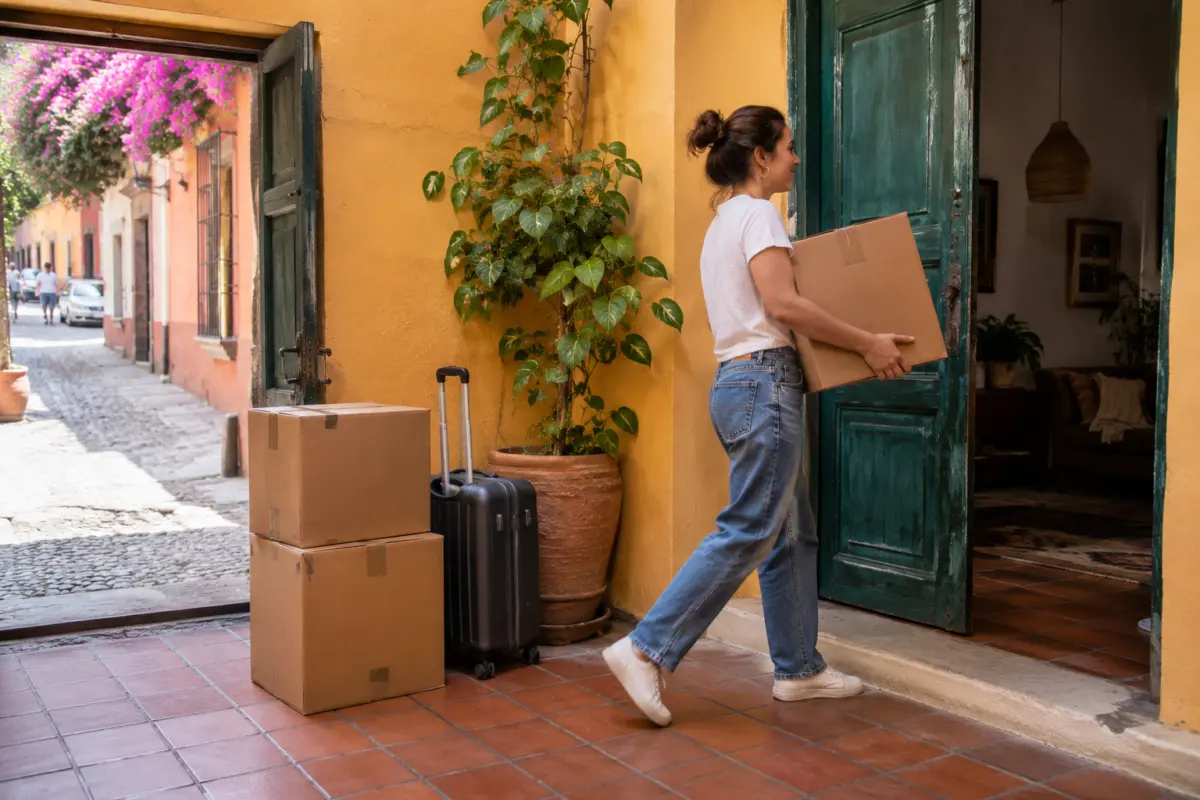
To move to Mexico from the USA, identify a residence category you qualify for, apply through the appropriate Mexican consulate, and complete the resident-card process with Mexico’s immigration authority, INM, after entering the country. For the standard consular temporary-residence route, plan to submit the card-exchange application within 30 calendar days of arrival. Arrange housing, healthcare, money access and any customs paperwork around that immigration sequence.
For the eligibility decision before you move, check our Mexico permanent residency requirements. It separates direct consular applications, qualifying family cases and the change after four years of temporary residence.
A U.S. passport makes a short visit different from a long-term move. Visiting without a visa does not establish Mexican residence, guarantee a 180-day admission or authorize every type of work. Start with your purpose and evidence before choosing a moving date.
Reviewed November 4, 2026. This guide explains how to move to Mexico from USA as a U.S. citizen. It includes a practical moving checklist and budget worksheet; financial examples are tied to the named consulate rather than presented as one national dollar requirement.
If you are still comparing destinations, our Costa Rica relocation guide for U.S. readers explains its Pensionado, Rentista and digital-nomad options, document preparation and post-approval tasks. Compare the actual work rights, healthcare and household budget; Mexico’s consular and INM sequence does not transfer to Costa Rica.
Who this relocation guide covers
The main audience is an American citizen moving to Mexico for a genuine long-term stay. A non-U.S. citizen living in the United States must also check the requirements for their nationality and evidence of lawful U.S. presence. Holding a U.S. green card does not turn that person into a U.S. citizen or automatically qualify them for Mexican residence.
Mexican citizens returning home, including people who also hold U.S. citizenship, have a different nationality and document situation. Confirm the correct entry documents and customs category rather than applying the foreign-resident checklist to yourself.
Separate three decisions: whether Mexico suits your daily life, whether you qualify for a residence route, and whether your planned work is permitted. A favorable answer to one does not settle the other two.
Can Americans move to Mexico? Choose a residence route first
Yes, Americans can seek Mexican residence when they meet the applicable requirements. The SRE temporary-resident visa service is an official starting point. Temporary residence generally covers stays longer than 180 days and up to four years, while permanent residence requires its own qualifying basis.
For the ordinary temporary route, use our Mexico temporary resident visa requirements and application checklist. It explains the qualifying evidence, statement format, form, photo and consular appointment before the later INM card exchange.
| Your situation | Route to investigate | Question to resolve before moving |
|---|---|---|
| You can support yourself from qualifying income or investments | Temporary residence through economic solvency | Which evidence and financial standard does your consulate currently accept? |
| You are retired and considering a permanent move | The applicable temporary or direct permanent-resident category | Does the permanent category accept your retirement circumstances and funds? |
| You have a qualifying Mexican or resident family connection | Family-unity procedure | Which relationship, sponsor status and application location apply? |
| A Mexican employer wants to hire you | Employment-related authorization and the appropriate visa | What must the employer obtain from INM before your consular appointment? |
| You have been accepted for a qualifying course | Temporary student residence when required | Do the course duration and financial evidence meet that category? |
The Mexican consulate in Denver’s category instructions illustrate these distinctions. Its ordinary temporary-resident card starts with one year and can subsequently be renewed for an allowed period within the overall temporary-residence limit. Follow the document actually issued and the current renewal procedure; do not assume every later card must be annual.
Buying a home does not itself grant residence. Property can be relevant to a specified eligibility route, but ownership, immigration approval and property-transfer formalities remain separate. Similarly, reaching retirement age alone does not establish permanent-resident eligibility.
How much income or savings must you prove?
Look up the current economic-solvency checklist for the consulate handling your application. Do not average several blogs’ dollar figures or substitute your expected Mexican living expenses for the qualifying financial requirement.
For example, the San Diego consulate’s 2026 temporary-resident checklist lists either qualifying employment or pension income of at least US$4,510 monthly for the previous six months, or a minimum monthly savings/investment balance of US$75,950 for the previous twelve months. It specifies complete original statements with an official bank stamp or bank letter, the applicant’s name and address, and additional employer evidence for the employment option.
Those are San Diego’s published examples, reviewed on the date above, for that category. Another office’s instructions, document format or later figures may differ. Recheck before your appointment, especially when applying in another calendar year.
Create a one-page evidence record: consulate, category, checklist date, income or balance route, required months, account holder, document format and any dependent requirement. If one month falls short, ask how that affects eligibility before assuming that a higher recent deposit fixes the whole history.
Working in Mexico and working remotely are different planning questions
A residence application based on financial solvency should not be treated as unrestricted permission to take a local job. The INM employment-offer procedure explains the employer-led authorization route. Its procedural requirements must be checked alongside current consular instructions.
For a U.S. employer, confirm in writing that working from Mexico is permitted by the employer and compatible with your immigration category. Also check payroll, professional licensing, data-security and tax implications. Calling yourself a digital nomad does not resolve those questions.
Use a simple description when requesting guidance: who pays you, where the employer or clients are, where you physically perform the work, and whether you will sell services in Mexico. A salaried remote employee, independent contractor and locally hired employee may need different advice.
Documents to prepare before leaving the United States
Use the selected consulate’s current checklist as the controlling packet. The following is a preparation framework, not a claim that every applicant needs every document.
- Identity: valid passport, requested copies and a photograph meeting that office’s specifications.
- Application: correct form, appointment confirmation and payment method.
- Eligibility: financial statements, pension or employment evidence, family records, admission letter or employment authorization, as applicable.
- U.S. presence: any evidence required when applying in the United States as a non-U.S. citizen.
- Family documents: relevant marriage, birth, custody or consent records, with authentication and translation only as required for the case.
- Arrival file: copies of the issued visa, travel details, initial Mexican address and current INM card-exchange instructions.
Do not order a criminal-record certificate or apostille for every document simply because a generic moving checklist mentions it. First establish which authority requires which document, where it was issued and the accepted form. Keep originals accessible during travel rather than inside a shipment.
If your passport needs renewal, review our U.S. online passport renewal guide early. Online renewal has eligibility and travel-timing conditions; do not begin a process that leaves your passport unusable during a consular appointment or departure.
How to move to Mexico from the U.S.: the application sequence
- Choose the category. Resolve the qualifying basis for each household member.
- Identify the consulate. Read its appointment, application-location, evidence and payment instructions. Use the office’s authorized booking channel.
- Build the evidence history. Gather the full required period of statements and route-specific documents.
- Attend the appointment. Present the packet and explain your actual plans. Be ready to supply additional information if requested.
- Check the issued visa. Verify the name, category, validity, entries and any instructions before booking the final move.
- Enter for the correct purpose. Present the residence visa and confirm the immigration record supports the card-exchange process.
- Complete the INM stage. Submit the required canje application within the applicable deadline, attend required appointments and retain the resulting documents.
Appointment availability, consular review, passport return and INM card production are separate waits. A posted processing estimate for one office is not an end-to-end relocation guarantee. Make major bookings flexible until the relevant approvals and documents are available.
The first immigration task after arrival: canje
Canje means the exchange into the Mexican residence document. Your consular visa and your resident card are different documents. For the standard temporary-resident route, the official INM-certified procedure on the Economy Ministry portal specifies a 30-calendar-day period after entry. Prepare to file promptly; this is not a promise that the physical card will arrive within 30 days.
At entry, show the residence visa and explain that you are entering to complete canje. Check the immigration record before leaving the checkpoint. If the record appears to show an ordinary visitor admission instead, seek correction from the responsible immigration authority immediately.
The INM canje checklist identifies the passport, valid visa, applicable entry document, basic form and fee receipt, together with the completed application. Confirm current appointment, entry-record and submission arrangements for the office responsible for your Mexican address.
Keep a small case tracker: entry date, filing deadline, application/reference number, submission acknowledgment, payment receipt, next appointment and collection instructions. An online form or appointment request alone should not be assumed to complete every filing requirement.
If international travel becomes necessary while the application is pending, ask INM which permission and documents are required before leaving. Do not assume a receipt has the same travel function as an issued residence card.
How much does it cost to move to Mexico from the USA?
Build two separate calculations: financial eligibility and cash you will spend. A qualifying account balance is not a government fee. Shipping charges, a refundable deposit and a monthly insurance premium are also different types of expense.
| Budget line | What to obtain | How to record it |
|---|---|---|
| Consular application | Current fee and payment method from your office | Per applicant; note whether refundable |
| INM resident document | Current charge for your category and authorized duration | Mexican pesos, separate from the consular fee |
| Document preparation | Actual copy, authentication and translation quotes | Only documents required for your case |
| Transport and belongings | Flight/driving and itemized mover or storage quotes | Include handling, insurance and potential storage |
| Initial accommodation | Temporary stay, deposit and first rent | Separate refundable deposits from spending |
| Healthcare | Written coverage quote and emergency-payment reserve | Check deductible, exclusions and start date |
| Recurring living costs | Housing, utilities, food, transport, school and communications | Monthly amount in MXN with dated conversion |
| Contingency | Your chosen margin for delays and unexpected costs | Keep accessible rather than tied up in a shipment |
A useful planning formula is: one-time nonrefundable costs + temporary deposits + the living-cost reserve you choose + contingency. Keep documented qualifying funds visible separately, especially if you need to maintain an evidence history.
For a transparent example, a hypothetical US$2,000 monthly household budget and a chosen three-month reserve produce a US$6,000 living reserve. That is arithmetic using an invented planning assumption, not a Mexican cost-of-living estimate, visa threshold or recommended minimum. Replace it with your own dated local quotes, then add the other worksheet lines.
Choose a neighborhood and housing before committing to a long lease
Start with daily needs: healthcare access, school or work travel, climate, internet, mobility and the cost of returning to the United States. Mexico City, Mérida, the Lake Chapala area and coastal destinations can offer very different routines. A holiday visit does not reveal every seasonal or neighborhood issue.
During a scouting stay, test the actual internet connection, water supply, street noise, transport and route to a suitable medical facility. Ask whether rent includes furniture, utilities, maintenance and parking. Verify the landlord’s authority and written deposit-return conditions before transferring money.
Read the current U.S. State Department Mexico advisory for state and route-specific guidance. A popular expatriate community is not a guarantee of safety, and a countrywide average cannot describe every neighborhood.
If you are still comparing destinations, our guide to moving to Portugal from the USA explains a different relocation route. Compare eligibility, healthcare and total setup costs rather than carrying one country’s immigration checklist into another.
Arrange healthcare before the move
Ask your existing insurer what it covers when you live in Mexico, not merely take a short trip. Compare the specific local providers, prescription access, pre-existing-condition exclusions, deductibles and emergency evacuation terms of any replacement policy.
Medicare usually does not cover care outside the United States, with limited exceptions. Travel coverage is not automatically suitable for residence. Do not cancel U.S. coverage based on a general relocation article; consider your return plans and the enrollment consequences first.
Check eligibility and enrollment conditions directly for any Mexican public program you intend to use. A residence card does not by itself mean immediate enrollment in every service. Keep medical summaries, generic medication names and an emergency-payment plan accessible during the transition.
Understand U.S. and Mexican tax obligations
Moving to Mexico does not automatically end U.S. filing obligations. The IRS guidance for citizens and residents abroad explains worldwide-income rules. Foreign tax credits or exclusions may apply when their conditions are met; they are not an automatic exemption for every expatriate.
Mexico’s residence analysis is separate from holding an immigration card. Article 9 of the Federal Fiscal Code addresses a home in Mexico and, where there is also a home abroad, the center of vital interests. Do not rely on “under 183 days means no Mexican tax residence” as a universal rule.
Before relocating, give a cross-border adviser your expected arrival date, homes, employment arrangement, business activity, investments and pension details. Ask separately about Mexican registration and returns, U.S. federal and state obligations, and foreign-account or asset reporting. Immigration approval does not settle those issues.
Moving household goods and furniture to Mexico
Compare bringing selected possessions, a full shipment and replacing items locally. Request an itemized quote showing customs-broker services, packing, border handling, insurance, storage and final delivery. A low transport quote may exclude the most important destination charges.
The Kansas City consulate’s 2026 household-goods instructions show the kind of identity, status, Spanish inventory and certification evidence an office may request. They also distinguish the residence documents relevant to the application.
Ask the consulate and customs broker which procedure fits temporary or permanent status, when the shipment may arrive and which goods qualify. Do not assume every resident imports everything permanently or tax-free. List electronics with identifying details where required, and treat new purchases, restricted items and vehicles separately from an ordinary used-household-goods inventory.
Should you bring your U.S.-plated car?
Check your immigration status, the route and customs zone, vehicle eligibility, ownership or lender permission, insurance and the required import procedure before driving south.
The 2026 foreign-trade rules, rule 4.2.7, identify visitor, temporary-resident and temporary-student categories for the ordinary foreigner temporary-vehicle-import procedure. Do not assume Mexican permanent-resident status has the same entitlement. Confirm the current details with Banjercito and customs, including any geographic exception.
Record the permit’s conditions, return or cancellation obligations and any deposit separately. If you later change residence status, revisit the vehicle arrangement before that change. Selling the U.S. vehicle and buying locally is another option to compare after obtaining real quotes.
Moving to Mexico with pets: check the current species-specific rules
Do not rely on old advice that all dogs and cats from the United States need no health paperwork. The current USDA APHIS Mexico pet-travel guidance states that, effective August 3, 2026, pet dogs need New World screwworm inspection documentation. It specifies a certificate signed by a USDA-accredited veterinarian and issued no more than five days before travel, without APHIS endorsement.
The same page treats cats differently: they do not need the health or NWS inspection document for entry into Mexico, but remain subject to inspection on arrival. Pet birds have separate instructions. Check the actual species section rather than adding animals to the wrong form.
Confirm airline or carrier rules, carrier cleanliness and inspection arrangements. Then check the rules for returning to the United States separately; outbound Mexican entry documents do not automatically satisfy U.S. re-entry requirements. Recheck close to departure because animal-health measures can change.
Moving to Mexico with family
Make a separate immigration row for each person: nationality, category, passport, evidence, appointment, visa and arrival deadline. One household member’s eligibility does not automatically approve everyone else. Resolve dependency, relationship and consent requirements before buying tickets.
For children, ask prospective schools about admissions, previous records, language support, term dates, transport and the full fee schedule. For a family member with ongoing medical needs, confirm an appropriate provider and coverage before selecting a neighborhood.
Keep essential civil and medical documents in your hand luggage, with secure copies available. If family members arrive separately, check each person’s entry and card-exchange timeline rather than using the first arrival date for the whole household.
First 90 days: turn legal residence into a workable daily routine
Prioritize the immigration deadline before optional setup tasks. After the resident document is issued, check the recorded personal details and any associated CURP information. A CURP is a population identifier; an RFC is a tax identifier. Neither should be confused with the residence approval itself.
Ask the chosen bank or service provider for its actual account requirements, including identity, address and any tax information. Keep the old account accessible during the transition where the provider allows your new residence; do not assume an account can retain an inaccurate U.S. address indefinitely.
Arrange communications, utilities and medical access, then replace provisional budget numbers with actual spending. Learn enough Spanish to discuss dates, addresses, invoices, appointments and emergencies. If an address or employment situation changes, check the relevant notification obligation with INM.
How hard is it to move to Mexico? Resolve these problems early
| Problem | Useful next action |
|---|---|
| Blogs show conflicting financial amounts | Record one current consulate/category checklist and ask about the exact evidence you hold. |
| Statements cover too few months | Obtain the missing history; do not treat a screenshot of today’s balance as equivalent. |
| The appointment wait threatens your move date | Change flexible travel plans rather than assuming the visa will be issued by departure. |
| The entry record appears inconsistent with canje | Contact immigration promptly and keep the visa and entry evidence available. |
| The card is delayed or you need to leave Mexico | Ask the responsible INM office about the case and required travel permission before departing. |
| The household shipment arrives before documents are ready | Ask the broker about lawful clearance requirements and storage charges before dispatch. |
The practical difficulty depends on your route, evidence history, consular availability, household needs and arrival arrangements. Meeting an income figure alone does not remove the remaining steps. If a legal deadline has already been missed, obtain case-specific guidance rather than assuming either an automatic fix or an inevitable restart.
Your moving-to-Mexico checklist
- Before applying: choose the route and consulate; check every family member’s eligibility and evidence history.
- Before committing money: compare housing, healthcare and moving quotes; separate eligibility funds from expenses.
- After visa issuance: check validity and entry instructions; organize the INM packet and initial Mexican address.
- Before departure: confirm insurance, money access, pet rules, shipment/customs arrangements and vehicle permissions.
- At arrival: verify the immigration record and calendar the applicable canje deadline immediately.
- During the first month: complete the required filing steps and appointments; retain application and payment evidence.
- As you settle: verify card details, banking, tax registration where applicable, healthcare and future renewal reminders.
The month-by-month organization above is an editorial planning aid. The 30-calendar-day canje requirement is an official procedural deadline; optional housing, language and budgeting tasks do not extend it.
For a retirement move, use our Mexico retirement residency guide for Americans to compare retiree routes, pension evidence and household planning before finalising the relocation timeline.
Frequently asked questions
Can I move to Mexico without a job?
Potentially. A qualifying financial-solvency, retirement or family route may not require a Mexican job offer. You still need to satisfy the selected category and consulate’s evidence requirements; a plan to find work later is not a substitute for eligibility.
Can I live in Mexico permanently on a tourist admission?
A visitor admission does not establish permanent residence. Follow the actual authorized stay and investigate the appropriate residence procedure. Do not use repeated border trips as a guaranteed long-term residence strategy.
Is the money needed to qualify the same as the cost of moving?
No. Required income or account balances demonstrate eligibility. Government fees, travel, moving services, deposits and living expenses belong in a separate cash budget. Track both calculations before committing to the move.
Must I receive my resident card within 30 days of arrival?
For the standard temporary-resident canje route, prepare to submit the required application within 30 calendar days after entry. That deadline does not guarantee card production or delivery within 30 days. Retain filing evidence and follow the responsible INM office’s instructions.
Does moving to Mexico end my U.S. tax filing obligations?
No automatic end should be assumed. U.S. citizens remain subject to applicable worldwide-income filing rules, while Mexican tax residence and reporting require a separate assessment. Check available relief and reporting duties for your circumstances.
Official sources and scope
This guide draws on SRE and consular instructions, INM’s canje checklist, the INM-certified government procedure portal, SAT customs rules, IRS and Medicare guidance, and current USDA APHIS pet-travel instructions. Named consular examples are dated and category-specific. Confirm the handling office’s current instructions before paying or travelling; this article is a planning guide, not an application, appointment service or individual eligibility decision.