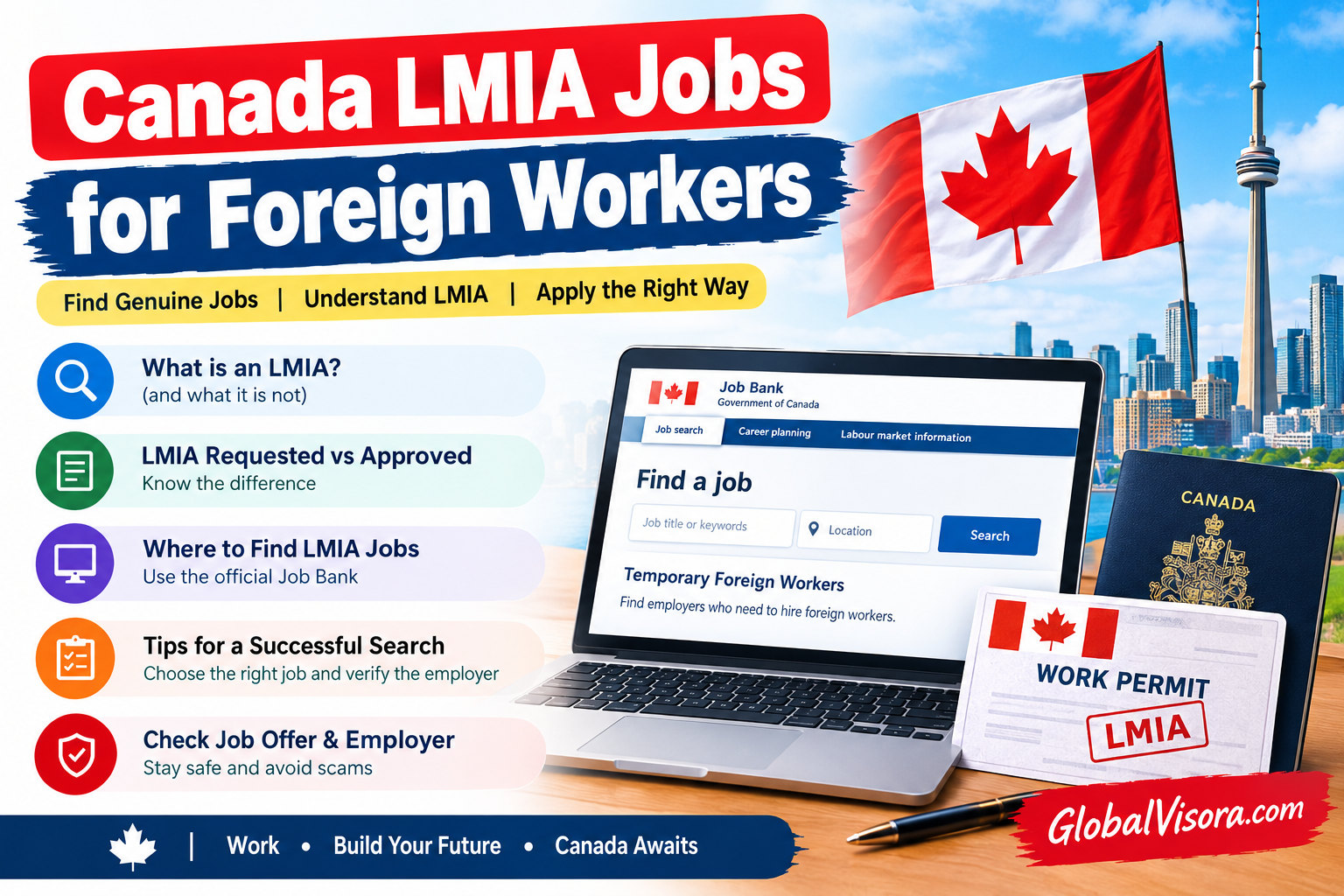
Finding Canada LMIA jobs for foreign workers starts with understanding what an LMIA listing does—and does not—mean. The Government of Canada’s Job Bank has a Temporary Foreign Workers section where employers have obtained or applied for a Labour Market Impact Assessment (LMIA). A listing can help you identify a potential lead, but it is not a job offer, a work permit, or a promise that the employer will hire someone applying from abroad.
The safest approach is to search for work that genuinely matches your skills, check the exact LMIA status shown in the advertisement, verify the employer and job details, and apply through a traceable channel. If an employer selects you, you may still need to qualify for a separate work permit before you can work in Canada.
Information checked October 18, 2026. Immigration and job-posting details can change. Confirm the current rules for your own situation before paying fees, travelling, or beginning work.
What an LMIA is—and what it is not
A Labour Market Impact Assessment is an assessment an employer may need from Employment and Social Development Canada (ESDC) before hiring a temporary foreign worker. The assessment considers the employer’s request to fill a position with a foreign worker. In many cases, an employer needs a positive LMIA before the prospective worker can apply for an employer-specific work permit. Some work-permit routes are LMIA-exempt, so not every job in Canada requires one.
An LMIA belongs to the employer’s hiring process. It does not, by itself, grant a foreign worker permission to enter Canada, work, or become a permanent resident. The worker must follow the correct immigration process and meet the applicable requirements. For a general overview of eligibility and documents, see GlobalVisora’s Canada Work Permit Requirements guide.
Understand “LMIA requested” and “LMIA approved”
Job Bank advertisements may show different LMIA statuses. LMIA requested generally means the employer has applied and is waiting for a decision. It is not an approval. LMIA approved means the employer has received permission to hire a foreign worker for the position covered by that assessment. Read the full listing and its dates; don’t treat an old approval or a status label as proof that the job is still available.
Even an approved LMIA does not mean you have been hired or that your work permit will be approved. The employer still has to select you, give you the relevant employment information and follow the required steps. Immigration officers make the decision on a work-permit application.
Where to search for LMIA-related jobs
Start with the official Job Bank Temporary Foreign Workers search. Job Bank says its search is free and allows you to look at employers who want to recruit temporary foreign workers. You can search by job title or keywords and location, then review details such as the employer’s name, work location, salary, posting date and application method.
Search with a specific occupation and location rather than relying only on the broad phrase “LMIA jobs.” Try the job title used in your experience, closely related titles and the city or province where you could realistically work. You can also review employer career pages and established job sites, but verify a vacancy against the employer’s own information. A third-party website displaying the word “LMIA” does not establish that a government assessment was approved.
How to search more effectively
- Choose work you can actually do. Compare the job’s duties with your training, licences and experience. Do not apply for a role simply because its title sounds familiar.
- Filter by location. Check whether you can relocate, what the commute or housing situation might be, and whether the stated worksite matches the vacancy.
- Read the complete advertisement. Note wages, hours, employment duration, start date, required experience and the application method.
- Check the status and date. Record whether the listing says an LMIA was requested or approved, and when the job was posted or updated.
- Apply through the named process. Use the employer’s official careers page or the application route identified in the listing. Keep copies of what you send.
Job availability changes. A page or social-media post listing “current LMIA jobs” may be outdated, copied, or disconnected from a real vacancy. Recheck the original advertisement before sending personal documents.
How to check a job offer and employer
Before sharing sensitive information, confirm that the employer named in the offer is the same organization shown in the advertisement. Look for a consistent company name, business address, website, contact details and description of the work. Contact the employer using information you independently find on its official site—not only a phone number or email provided by an intermediary.
Compare the offer letter with the job posting. The occupation, duties, work location, wages, hours, start date and employer name should make sense together. Ask for a written agreement that explains the job and its conditions. If the employer says an LMIA is approved, ask what information or documents the employer will provide for the work-permit process. A screenshot, certificate image, or copied approval letter sent in a chat is not enough to establish that the offer is genuine.
Be cautious if the person contacting you cannot explain the job, changes the employer name, avoids a proper interview, or pressures you to send money or passport details immediately. A legitimate vacancy can still be difficult to assess from abroad; take time to confirm it.
Prepare an application that fits the vacancy
Use a clear résumé that accurately describes your relevant experience, qualifications and skills. Match its wording to the real duties in the advertisement without copying credentials or claiming licences you do not hold. Add concise examples of work you have done that show how you meet the employer’s requirements. If a licence, trade certificate, language ability or safety training is requested, state your actual status and whether you can provide evidence.
Follow the employer’s application instructions. Include only the personal information reasonably needed at that stage. Keep a record of the job number, application date, employer contact and documents submitted. If you are invited to interview, ask practical questions about the duties, supervisor, location, compensation and schedule. Do not resign from current work, borrow heavily, or buy non-refundable travel based only on an interview or verbal promise.
What happens after an employer selects you?
If the role needs an LMIA, the employer is responsible for the LMIA process. If a positive assessment is required and obtained, the employer should provide the relevant details and job documents for your application. You then apply for the appropriate work permit and submit the information required for your circumstances. Application instructions can differ depending on whether you apply from outside Canada, inside Canada, or through another eligible process.
An employer-specific work permit is tied to the conditions printed on the permit, which can include the employer, occupation and location. Do not assume you can begin work as soon as an employer says “the LMIA is ready.” Wait until you have the required authorization and understand its conditions. Review GlobalVisora’s Canada Visa Fees guide for a general cost overview, then confirm current government fees before applying. Work-permit fees are separate from an employer’s LMIA costs.
Fees: what a worker should not pay for
Job Bank states that employers should never ask a worker to pay them to get hired and that the employer cannot make the worker pay for the LMIA. Treat requests to “buy an LMIA,” pay for a guaranteed position, or reimburse the employer’s LMIA-processing cost as serious warning signs. Don’t send money to a personal account, cryptocurrency wallet, or an unverified agent based on a promise of a job or visa.
Some costs may legitimately belong to the applicant, such as the applicable work-permit application fee and, where required, biometrics or a medical examination. Those are different from an employer’s LMIA or recruitment costs. Ask for a written explanation and receipt for any payment you are told to make; check current official instructions and local worker-protection rules if uncertain.
Warning signs of a job or LMIA scam
- A person promises a guaranteed LMIA, work permit, visa, or permanent residence.
- You are told to pay the employer’s LMIA fee or pay to “reserve” a job.
- The offer arrives without a credible hiring process, or the company cannot be independently verified.
- The job details are vague, inconsistent, or different across the advertisement and offer letter.
- You are pressured to act immediately, keep the offer secret, or communicate only through a personal messaging account.
- Someone asks to keep your passport or other original identity documents.
A single warning sign does not prove a particular employer committed fraud, but it is a reason to pause and verify. Never use false documents or provide misleading information in a job or immigration application. Keep messages and receipts if you believe someone is attempting to defraud you, and use the appropriate official reporting channel.
Worker rights and changing employers
Temporary foreign workers in Canada have workplace rights. An employer cannot use immigration status as permission to withhold wages, take personal documents, or force work outside the applicable agreement. Job Bank explains that a worker may look for another employer, but the worker may need to change the work permit before starting a different job. Check your actual permit conditions and get official guidance before changing employers or duties.
If you experience abuse, unsafe work, unpaid wages, or pressure to repay recruitment costs, keep relevant records and seek help through the appropriate federal or provincial/territorial service. Do not assume that reporting a concern automatically changes your immigration status or authorizes work for a new employer.
Common misunderstandings
- “Every Canadian job needs an LMIA.” No. Some pathways are LMIA-exempt; the employer must identify the correct route.
- “The job listing says LMIA, so I’ll get hired.” No. The employer still chooses candidates, and an advertisement is not an offer.
- “An approved LMIA is my work permit.” No. Where required, it supports a separate work-permit application.
- “An LMIA job guarantees permanent residence.” No. Permanent-residence eligibility is assessed under a separate immigration program.
- “I should pay an agent to secure the LMIA.” Do not pay someone for the employer’s LMIA or a guaranteed job. Verify any professional service and fee separately.
Practical checklist before you apply
- Does the job match your real experience, qualifications and licences?
- Is the employer identifiable and independently verifiable?
- Does the listing say “LMIA requested” or “LMIA approved,” and is it current?
- Do the job duties, location, wages and hours match across the listing and offer?
- Have you confirmed whether the employer’s route requires an LMIA?
- Have you avoided paying for an LMIA, a guaranteed job, or a promised permit?
- Have you checked the work-permit process and fees that apply to your own location and situation?
- Will you wait for the required authorization before starting work?
Bottom line: Treat an LMIA-related vacancy as a lead to investigate, not as immigration approval. Search through traceable sources, confirm the employer and job independently, understand the exact LMIA status, and apply for the correct work permit only after the required employer documents are available. No job posting or recruiter can promise the government’s decision.