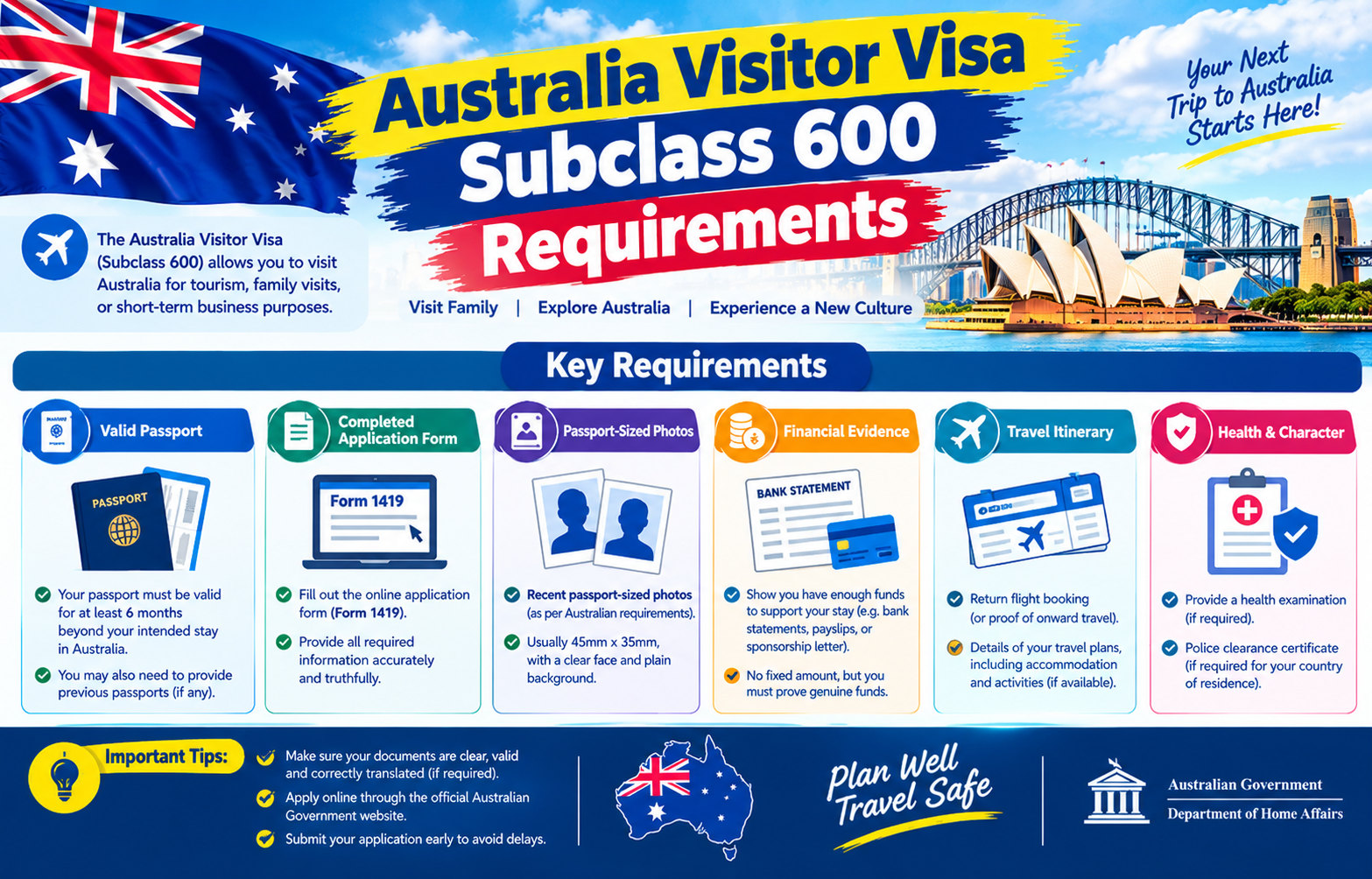
Australia’s Visitor visa (subclass 600) includes several streams, and their rules are not interchangeable. This guide focuses only on the Tourist stream for applicants applying from outside Australia. It is generally for people visiting Australia as tourists, visiting family or friends, or taking a cruise. Your passport, travel purpose and personal circumstances affect what you need to provide. The Department of Home Affairs assesses each application individually; no checklist, invitation letter or bank balance guarantees a grant.
Sources checked October 14, 2026. Home Affairs’ live subclass page and the document prompts in your own ImmiAccount application take priority if requirements change. Do not use this guide as instructions for the onshore Tourist stream, Sponsored Family stream, Business Visitor stream, ETA or eVisitor.
What the offshore Tourist stream is for
The Tourist stream is intended for a temporary visit. Depending on your plans, that may mean a holiday, visiting relatives or friends, or a cruise. It is not a work visa. Study or training may be permitted for up to three months, but if studying is the main reason for your trip, check whether a student visa is more appropriate. Business visitor activities and medical treatment have separate rules and may require a different stream or visa.
The stay period and entry arrangements are decided for the individual grant. Do not assume that every applicant receives the same length of stay, a multiple-entry visa or permission to remain for a particular period. Read the grant notice and check the conditions attached to your visa before booking travel. If your plans involve work, a long course, treatment or another activity outside a temporary tourist visit, stop and confirm the correct visa route first.
The offshore Tourist stream has a location requirement: you must be outside Australia when you apply and when Home Affairs makes its decision. If you are already in Australia, read the separate onshore Tourist stream rules instead. Also check whether your passport may qualify for another visitor option, such as an ETA or eVisitor, before preparing a subclass 600 application.
Eligibility: the questions to check first
Before gathering documents, review the official Visitor visa (subclass 600) Tourist stream page for applicants outside Australia. Confirm that your visit is temporary and fits the stream, that you can support yourself or have appropriate support, and that you can meet the relevant health, character and other visa criteria. The Department may ask for further information or decide an application based on what was submitted.
There is no universal income level or fixed bank balance that guarantees approval. The useful question is whether the evidence makes sense for the trip you describe: its length, accommodation, planned activities, who will pay and your own circumstances. The assessment is not a points score in which one document automatically secures a visa. Provide accurate information and evidence that fits together.
Documents to prepare for your circumstances
Use the Home Affairs “gather your documents” instructions and the personalized requests shown in your application. The following groups help you organise relevant evidence; they are not a claim that every applicant must submit every item.
1. Identity and passport information
Prepare the pages of your current passport showing your photograph, personal details, issue date and expiry date. Provide a national identity card if you have one, and documents showing a name change if relevant. Check that the spelling of your name, birth date and passport details match across the application and supporting records. If you plan to renew your passport, check the Department’s instructions before applying so you use the correct travel document details.
2. Purpose and plan for the visit
Explain why you want to visit, the approximate dates and what you plan to do. An itinerary can make the purpose and length of the trip easier to understand, but it should reflect your actual plans rather than an invented schedule. If you are visiting family or friends, an invitation letter may explain the relationship, purpose and length of the visit, and whether you will stay with the host. An invitation is supporting information—not a visa grant, a substitute for your application, or proof by itself that you qualify.
If you are attending a particular event or visiting someone for a specific reason, include relevant evidence when it supports the explanation. Avoid buying non-refundable tickets simply to create an itinerary. Home Affairs advises applicants not to arrange travel until the visa has been granted in writing.
3. Funds and who will pay
Show how the costs of the visit and departure will be covered. Depending on your situation, relevant records may include itemised personal bank statements covering a period, payslips, tax records, audited accounts, term deposits or credit-card statements. Use evidence that is genuine, readable and consistent with the source of your income or savings. There is no official fixed amount that guarantees success, so do not borrow money temporarily or alter a statement to make the balance look stronger.
If a relative or friend will pay some or all of your expenses, explain what they will cover and provide evidence of their funds where relevant. Their support does not remove the need to answer the application questions accurately or establish your identity and travel purpose. For a deeper explanation of how to present financial evidence without relying on a single balance, see our proof-of-funds guide.
4. Circumstances supporting a temporary visit
Provide truthful information that helps explain your situation and plans after the visit. Depending on your circumstances, this might include a letter from an employer about your job and approved leave, evidence of current study, immediate family responsibilities, or other commitments. Home Affairs’ examples also include evidence that you can return home or own significant assets there. These are examples, not mandatory documents for every person. Choose evidence that is relevant to your life instead of collecting papers that do not explain anything about your application.
5. Children and applicants under 18
Children have additional identity and consent considerations. Home Affairs may ask for a birth certificate showing parents’ names, proof of guardianship where applicable, and consent from a person with parental responsibility who is not travelling. The Department specifies the relevant consent form or statutory declaration and supporting identity document. If a child will stay with someone other than a parent or legal guardian, a separate undertaking may be required. Check the current instructions for the child’s precise circumstances; do not rely on an adult checklist.
6. Translations, scans and requested checks
Non-English documents must be translated into English as instructed by Home Affairs. The translator details required can differ depending on whether the translation is completed in Australia or overseas. Upload both the original and translation when required. Scan or photograph documents in colour, make sure the text is legible, and keep a multi-page document together as one file if the system asks for it. Attach each document in the appropriate category and avoid uploading the same item repeatedly.
Health examinations, biometrics or police documents depend on the applicant and the Department’s instructions. Do not assume every person must book all checks before applying. Follow any request you receive and its deadline. Our visitor visa application checklist can help organise general preparation, but the subclass-specific Home Affairs list should control your final checklist.
How to apply from outside Australia
- Confirm the route. Check that the offshore Tourist stream fits your passport, location and genuine travel purpose. Compare other options only if the official eligibility information says they may apply.
- Read the current subclass page. Review eligibility, conditions, location requirements, document instructions, fees and the “after you apply” section.
- Prepare your evidence. Organise identity, travel purpose, financial support, circumstances and any child-specific or translated documents that apply to you.
- Use ImmiAccount. Create or sign in to the account and select the correct Visitor visa application. Answer each question accurately and save your work as you go.
- Attach and review. Upload clear documents in the requested categories. Compare names, dates, travel plans and financial explanations across the form and evidence.
- Submit and pay. Follow the prompts to lodge the application and pay the current charge. A saved or incomplete application is not the same as a lodged application.
- Keep the confirmation. Save the application reference, payment record and a copy of the completed form and uploaded files.
The official ImmiAccount application guide explains how to start, continue and manage eligible applications. Each family member generally needs their own application, although related applications may be submitted together where the system allows. Check the instructions for each applicant, including children.
Fees and processing time
The visa application charge can change and may depend on the applicant and application circumstances. Check the amount displayed in the official process immediately before lodgement rather than relying on an old blog, screenshot or another person’s receipt. Budget separately for possible medical examinations, biometrics, translations or payment-provider charges; these are not necessarily part of the visa application charge.
Home Affairs’ processing-time guide uses recently decided applications to provide an indication, not a personal promise. The time for an individual case can differ, particularly if information is missing or further checks are needed. Avoid making non-refundable travel plans based on a processing estimate. For general planning, see our visa processing time guide, then check the current official estimate for your visa.
After you submit
Check ImmiAccount and the email address linked to the application for updates. If Home Affairs requests additional information, read the notice carefully, respond by the deadline and use the specified upload method. The Department may decide the application without requesting missing material, so submitting a complete and accurate application matters. If your passport, contact details or other relevant circumstances change, follow the Department’s instructions for notifying it.
Wait for the written decision before travelling. If the visa is granted, check the permitted stay, entries and all conditions in the grant notice. A grant does not necessarily mean you can stay for the maximum period you expected. If refused, read the notice for the reasons and any review rights or deadlines that apply to your case; review options are not identical for every applicant.
Common mistakes to avoid
- Using advice for the onshore Tourist stream or another subclass 600 stream as if it applied to an offshore Tourist application.
- Assuming a fixed bank balance, a large deposit or an invitation letter guarantees a grant.
- Providing travel dates or funding explanations that conflict across the form and documents.
- Using an old fee amount, outdated form instructions or another applicant’s document checklist.
- Uploading unclear scans, omitting required translations or missing a request deadline.
- Assuming a saved form has been submitted or paying through an unofficial website.
- Booking non-refundable travel before receiving the written visa decision.
Frequently asked questions
Can I apply for this Tourist stream while I am in Australia?
This guide covers the Tourist stream for applicants applying outside Australia. Home Affairs has separate rules for applying in Australia, including location and visa-status criteria. Read the onshore Tourist stream page if you are already in Australia; do not use the offshore instructions as a substitute.
How much money do I need for an Australian Visitor visa?
There is no single balance that guarantees a grant. Explain how the trip will be funded and provide genuine evidence that fits the proposed length, accommodation and activities. If someone else will pay, explain their support and provide relevant evidence of their capacity.
Do I need to buy a flight before applying?
Do not buy non-refundable travel simply to support an application. Home Affairs advises applicants not to arrange travel until it has confirmed the visa grant in writing. An itinerary can describe intended plans without committing you to a non-refundable ticket.
Does every applicant need biometrics or a medical examination?
Not necessarily. Follow the instructions for your own application and any request from Home Affairs. Requirements can depend on the individual case, so do not assume that another applicant’s experience applies to you.
The practical approach is to confirm the correct stream first, build a document set around your actual visit, submit accurate information through the proper channel, and wait for the written outcome before travelling. Always use the current Home Affairs instructions when they differ from a general guide.