Prepared and reviewed by: GlobalVisora Editorial Team
Last reviewed: September 10, 2026
Verification scope: Seasonal forecast interpretation and winter-safety advice were checked against Environment and Climate Change Canada and federal emergency-preparedness guidance linked below.
Next review due: December 2026, or earlier when ECCC releases a materially revised outlook.
Searches for Canada’s 2026–27 winter outlook are rising, but a seasonal outlook is not a day-by-day snow forecast. Environment and Climate Change Canada (ECCC) publishes probability maps showing whether average temperature or precipitation is more likely to be above, near or below normal. Newcomers and international students should use those maps for broad planning and switch to local forecasts and alerts for daily decisions.
Bottom line: Do not plan a move, flight or winter budget around a sensational “coldest winter ever” headline. Check the official seasonal map for context, then use local warnings and the WeatherCAN app as your arrival date approaches.
What the official seasonal outlook actually shows
ECCC’s long-range system publishes outlooks for periods such as months 1–3, 2–4 and longer lead times. The maps estimate probabilities for three categories: above normal, near normal and below normal. “Above normal temperature” refers to the seasonal average relative to the climate baseline; it does not mean every day will be warm or that snowstorms cannot occur.
White areas on the probability map generally mean no category reaches the system’s confidence threshold. Forecast skill also varies by place, variable and lead time. Precipitation outlooks are often less confident than temperature outlooks, especially farther into the future.
How to read a Canada winter forecast
- Open ECCC’s current probabilistic temperature and precipitation maps.
- Select the forecast period covering your arrival or first months.
- Find your province and nearest city or region.
- Read the probability for all three categories, not only the most colourful map.
- Check the reliability or forecast-skill information.
- Recheck nearer the date and use local daily forecasts and alerts.
A seasonal probability cannot tell you whether a flight will be cancelled on a particular date. Short-range warnings for snowfall, freezing rain, blizzard conditions, flash freeze, extreme cold and poor visibility are more relevant to immediate travel.
Why location matters
Canada’s winter differs substantially by region. Coastal British Columbia is often milder and wetter than inland or Prairie cities. Southern Ontario and Quebec can experience snow, freezing rain and rapid temperature changes. Prairie and northern regions can face extended extreme cold and wind chill. Atlantic Canada may see strong winter storms and changing coastal conditions.
Prepare for the city where you will live, not for a single national forecast. Housing quality, commute length, access to public transport and the time spent outdoors can matter as much as the recorded temperature.
Winter clothing checklist for newcomers
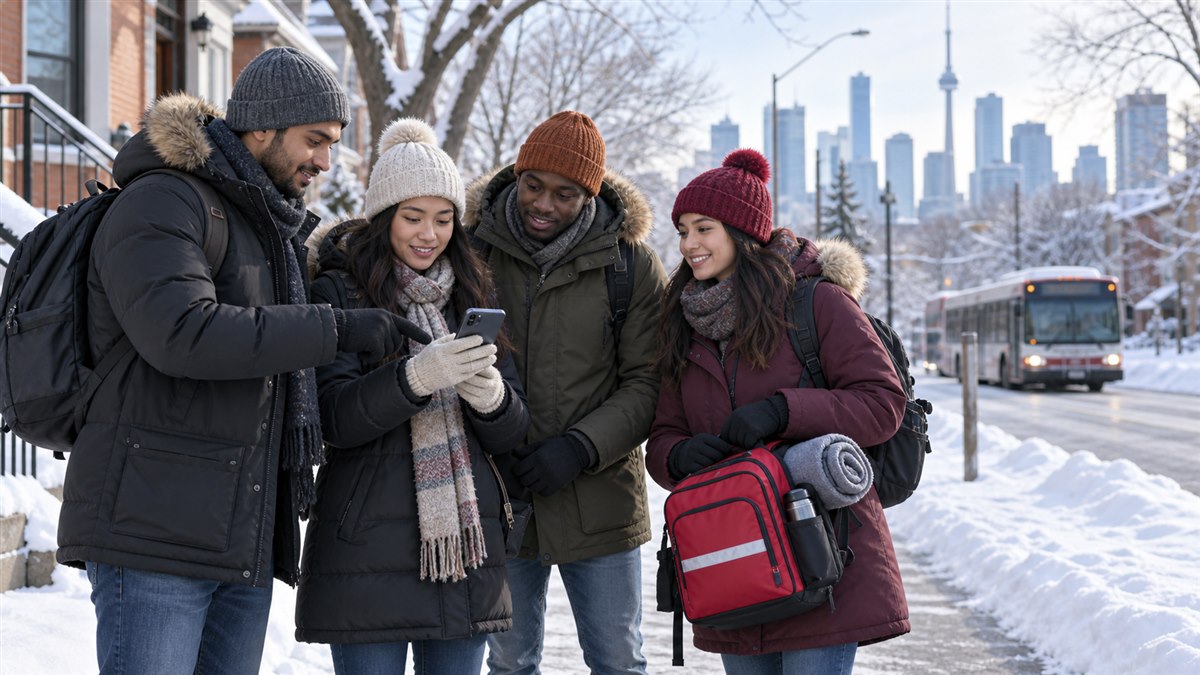
- insulated winter coat with a wind-resistant outer layer;
- waterproof, insulated boots with good traction;
- warm socks and moisture-managing base layers;
- mittens or insulated gloves;
- warm hat or toque that covers the ears;
- scarf or face covering for wind chill;
- reflective accessory for dark commuting hours; and
- spare dry gloves or socks for long days.
Layering is more flexible than relying on one heavy garment. Avoid remaining in wet clothing, because moisture increases heat loss. Buy for the local climate and your routine rather than choosing clothing only by appearance.
Housing and heating questions
- Is heat included in rent, and who controls the thermostat?
- Which utilities are the tenant’s responsibility?
- Are windows and doors properly sealed?
- Who clears snow from entrances, steps and parking areas?
- What happens if heating or electricity fails?
- Are smoke and carbon-monoxide alarms installed and working?
Never use a barbecue, camping stove or fuel-burning generator indoors or in an enclosed area. Government emergency guidance recommends certified carbon-monoxide alarms and keeping generators well away from buildings.
Public transport, driving and flight preparation
Build extra time into winter commutes and check service alerts before leaving. Ice can make a short walk slower and more dangerous. Keep a charged phone, portable power bank and the address of a heated indoor location.
Drivers should prepare a vehicle emergency kit, monitor provincial winter-tire rules and understand snow-route parking restrictions. For flights, avoid unprotected connections when possible, monitor the airline and airport, and keep medicine and essential documents in carry-on baggage.
Arrival-week checklist
- Install WeatherCAN or enable trusted local alerts.
- Learn the meaning of snowfall, freezing-rain, blizzard and cold warnings.
- Buy essential layers and waterproof footwear.
- Test the heating and alarms in your accommodation.
- Map an indoor or underground route for regular travel where available.
- Create a small home and vehicle emergency kit.
- Save school, employer, landlord and municipal emergency contacts.
Common mistakes
- Treating a national seasonal outlook as a precise city forecast.
- Equating “above-normal temperature” with no severe cold events.
- Buying fashionable boots without waterproofing or traction.
- Ignoring wind chill and wet clothing.
- Waiting for a storm before preparing medication, food or backup power.
Frequently asked questions
Can anyone predict every Canadian snowstorm months ahead?
No. Seasonal models describe broad probabilities. Specific storms require shorter-range forecasts and warnings.
Does a warmer-than-normal winter mean little snow?
Not necessarily. Temperature and precipitation are separate variables, and major snow or ice events can occur within a season whose average temperature is above normal.
Where should newcomers check alerts?
Use Environment and Climate Change Canada’s weather service, WeatherCAN and trusted provincial or municipal emergency information.
Official sources
- ECCC — Seasonal Forecasts
- ECCC — Probabilistic Temperature and Precipitation Outlooks
- Government of Canada — Winter Weather Preparation
- Government of Canada — Extreme Cold Preparation
This article explains public forecasts and general preparation. Conditions vary by location and can change quickly; follow current official warnings and emergency instructions.