
Australia skilled migration is not a single application or a simple list of “in-demand jobs.” Your route depends on the visa subclass, nominated occupation, qualifications, employment history, English ability, age, points and—where required—state or territory nomination or an invitation. The main points-tested options are the Skilled Independent visa (subclass 189), Skilled Nominated visa (subclass 190) and Skilled Work Regional (Provisional) visa (subclass 491). Each has separate criteria, and meeting a minimum threshold does not guarantee an invitation or visa grant.
Sources checked October 13, 2026. Occupation lists, assessing-authority rules, invitation arrangements and state nomination criteria can change. Recheck the exact official requirements when preparing an expression of interest (EOI) and again before lodging a visa application.
What “skilled migration” means
Applicants generally need an eligible occupation, a suitable skills assessment where required, an EOI through SkillSelect and an invitation before applying. The EOI records work history, qualifications, English results and points claims; it is not a visa application, job offer or permission to work.
Do not begin with a generic internet list of occupations. The relevant occupation list can differ by visa and stream, and an occupation name may be similar to your job title without matching the official description. Compare the tasks you actually performed, your qualifications and the nominated occupation’s assessment requirements. A job advertisement saying “sponsorship available” does not prove that the role fits a points-tested visa.
Compare the three main points-tested visas
Skilled Independent visa (subclass 189)
The 189 is a points-tested permanent visa that does not require state or territory nomination. Applicants still need to meet the visa’s occupation, assessment, points, invitation and other legal criteria. “Independent” does not mean automatic or open to every skilled worker: the occupation and program settings still matter, and an EOI must be competitive enough to receive an invitation.
Skilled Nominated visa (subclass 190)
The 190 is a permanent points-tested visa requiring nomination by an Australian state or territory. Nomination criteria are set by the relevant government and may include an occupation list, work or residence links, employment plans, English level or other evidence. A state nomination is not guaranteed by meeting the federal points threshold. Check the rules of the state or territory you are targeting, including whether it is accepting applications in your occupation and what commitments follow nomination.
Skilled Work Regional (Provisional) visa (subclass 491)
The 491 is a provisional visa connected to regional migration. Depending on the route, an applicant needs state or territory nomination or sponsorship from an eligible family member in a designated regional area. Regional res idence and work conditions matter after grant. The 491 may provide a pathway to a later permanent visa for people who meet its separate requirements, but that future outcome is not automatic. Verify the current regional-area definition and conditions for your specific circumstances.
Occupation eligibility: title, code and duties all matter
First identify the occupation that most accurately reflects your skilled work, not merely the title on a business card. Compare your day-to-day duties, level of responsibility, qualifications and employment history with the official occupation description. Different visas may draw on different skilled occupation lists, and a code that is usable for one route may not be accepted for another.
For regulated occupations, migration eligibility and professional registration are separate: a positive assessment does not necessarily authorize you to practise. Check the regulator in the state or territory where you plan to work.
Occupation lists and nomination priorities can change. Save the date and version of the official list you checked, but do not assume that a past invitation round or an old article predicts future selections. If your occupation has several plausible codes, resolve the distinction before paying for an assessment or claiming points.
Skills assessment: choose the right authority and assessment
A skills assessment is an evaluation by the authority responsible for an occupation. Depending on the occupation, the authority may review qualifications, employment evidence, training, registration or other criteria. Its process, documents, fees and processing arrangements are distinct from the visa process. The authority may require detailed employer references that describe duties, dates and hours rather than a generic confirmation of employment.
Before applying, confirm which assessing authority applies to your nominated occupation, whether your intended visa requires a suitable assessment, what date the assessment must be valid, and whether the result is suitable for migration purposes. Do not assume an assessment for a different visa, purpose or occupation will satisfy the requirement. If your qualification is not directly comparable or your work history spans several roles, read the authority’s evidence rules carefully or obtain qualified advice.
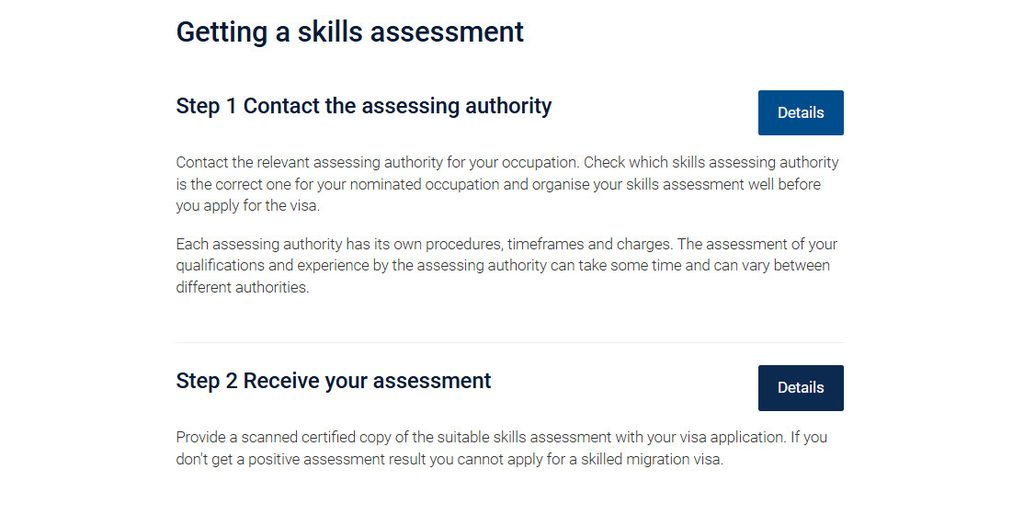
Keep the outcome letter and check its conditions and validity. If you change occupations, confirm whether a new assessment is needed. A positive result is not a visa grant or invitation.
Points, SkillSelect and invitations
The Department’s current SkillSelect guidance says applicants for subclasses 189, 190 and 491 must meet or exceed the 65-point threshold to be invited to apply. Points may be awarded for factors including age, skilled employment, educational qualifications and English-language proficiency. Other claims may be relevant under the applicable rules. The precise score depends on your circumstances and the law in force when you apply.
Sixty-five points is a threshold, not a prediction of selection. Meeting it does not guarantee an invitation; occupation demand, rankings and program settings affect outcomes. Use the official calculator as an estimate and verify every claim against the rules and evidence.
In SkillSelect, enter accurate information and keep the EOI updated when relevant circumstances change before an invitation. Include English test and skills-assessment details as required. If invited, follow the deadline stated by the Department; current guidance says an invited applicant has 60 days to lodge the visa application. An invitation does not remove the requirement to prove claimed qualifications, employment, English or other criteria. Keep the EOI consistent with the later application and explain any genuine change or discrepancy.
Documents to prepare before claiming points
- Identity: Current passport details and any identity or name-change records required for your circumstances.
- Qualifications: Certificates, transcripts and verification documents requested by the relevant assessing authority.
- Employment evidence: References with dates, hours, duties and employer details, supported where appropriate by contracts, payslips or tax records.
- English evidence: Test results that meet the relevant standard and remain valid when required.
- Assessment: A suitable skills-assessment outcome for the nominated occupation and visa pathway.
- Family claims: Relationship, partner-skill or other evidence only where you rely on it and the rules allow it.
Use consistent dates and job descriptions across forms and records. Do not inflate duties or claim unsupported qualifications or work experience. Follow the relevant translation and submission instructions, and keep copies of your evidence.
Common planning mistakes
- Choosing an occupation from a general shortage list without checking the relevant visa list and actual duties.
- Paying for an assessment before confirming the authority, code and assessment type.
- Treating 65 points or a past invitation round as a guarantee or forecast.
- Confusing an EOI with a visa, work permission or maintained lawful status.
- Assuming nomination is assured or regional visa conditions end at grant.
A practical route-selection checklist
- Choose the exact visa subclass you want to investigate: 189, 190 or 491.
- Match your genuine occupation and duties to the relevant official list and code.
- Confirm the assessing authority, evidence requirements and validity period for your occupation.
- Calculate points conservatively using current evidence; distinguish the minimum threshold from likely invitation competitiveness.
- For subclass 190 or a nominated 491 pathway, review the current state or territory program rules separately.
- Submit an accurate EOI, monitor it and update it when circumstances change.
- If invited, check the deadline and lodge a complete visa application with evidence for every claim.
Plan for timing and uncertainty
Skills assessments, state nomination and invitation rounds have separate processes and timelines. Processing estimates can change and are not promises. An EOI alone does not extend an existing visa, maintain lawful status or give work rights. If you are in Australia, check your current visa conditions and the correct process for remaining lawfully in the country. Consider a registered migration agent or Australian legal practitioner if your occupation match, points claims, prior immigration history or status is uncertain; verify credentials and do not rely on a guaranteed-outcome claim.
Official sources and related guidance
For the EOI steps, occupation-list checks, points threshold and invitation process, read the Department of Home Affairs’ SkillSelect expression-of-interest guidance. For the assessment process and its role in migration, consult the Department’s skills assessment guidance. These official pages and the detailed subclass criteria take precedence over this overview.
Considering study rather than skilled migration? See our Australia Student Visa Subclass 500 guide. A student visa and a skilled-migration visa serve different purposes and have separate eligibility and work conditions.
GlobalVisora is an independent information platform and is not affiliated with the Australian government. This article is general information, not personal immigration or legal advice. Always verify current requirements with the Department of Home Affairs and relevant assessing authority before acting.